A War Expanding Beyond the Battlefield
The ongoing confrontation involving the United States, Israel, and Iran has rapidly escalated into one of the most volatile geopolitical crises in recent years. Joint American-Israeli military operations targeting Iranian military infrastructure have intensified, with waves of airstrikes and naval engagements reshaping the regional security landscape. Israel has conducted extensive bombing runs against Iranian missile facilities and command centers, while Washington has provided strategic and operational support. Tehran, meanwhile, has vowed retaliation and accused Western powers of destabilizing the region. As the conflict widens, diplomatic tensions and security concerns are rippling far beyond the Middle East, drawing attention to the roles of other nations—including India.
India Rejects Allegations of Supporting US Military Operations
India has categorically dismissed allegations that the US Navy is using its ports to support military operations against Iran. The Ministry of External Affairs (MEA) called the claims “fake and false,” directly rebutting statements made by former US Army Colonel Douglas Macgregor during an interview on the One America News Network.
Macgregor had suggested that damage to US bases in the region forced Washington to rely on Indian port facilities for logistical support. India’s MEA swiftly countered the claim through its official FactCheck channel, warning against the spread of “baseless and fabricated comments.”
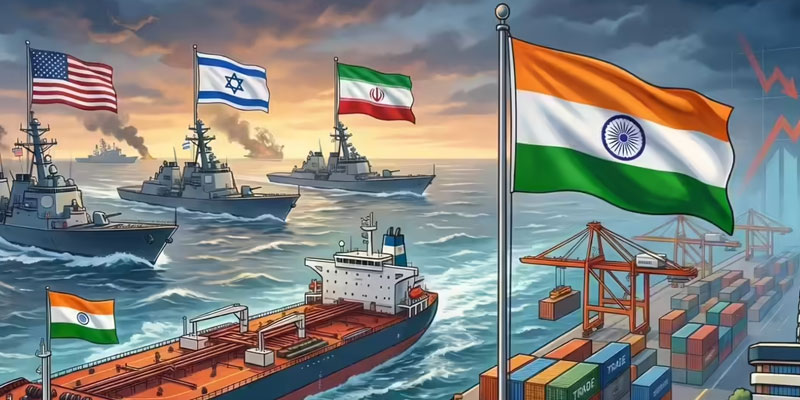
The strong response highlights New Delhi’s careful diplomatic positioning. India maintains growing security cooperation with the United States and partners in the Quad framework, but these partnerships are largely focused on the Indo-Pacific rather than Middle Eastern military campaigns. By rejecting the allegation quickly and publicly, India reinforced its long-standing commitment to strategic autonomy and avoided being drawn into the intensifying US-Iran confrontation.
Israeli Military Campaign Intensifies
At the same time, Israel has significantly expanded its offensive against Iranian military infrastructure. The Israeli Defense Forces launched new airstrikes targeting facilities in Tehran linked to the Islamic Revolutionary Guard Corps, including headquarters and intelligence sites.
Another operation reportedly destroyed a ballistic missile launcher in the holy city of Qom that was allegedly prepared for immediate launch. Israeli strikes also hit missile production facilities in Isfahan as part of a broader campaign known as Operation Epic Fury.
Since the beginning of the operation last weekend, Israeli forces have reportedly flown more than 1,600 sorties and deployed thousands of precision munitions. The goal, according to Israeli officials, is to degrade Iran’s missile production capabilities and weaken its command structure before Tehran can mount a sustained retaliation.
Political Divisions in Washington
The escalating military action has also triggered political debate within the United States. A bipartisan effort in the US Senate to limit President Donald Trump’s authority to continue military operations against Iran without congressional approval failed in a narrow 53-47 vote.
Democrats criticized the administration for bypassing congressional oversight while coordinating large-scale operations with Israel. However, Republican lawmakers largely supported the president’s strategy, signaling strong backing for an assertive military posture. White House officials have reinforced that US warnings to Iran are backed by overwhelming military capability and are not merely rhetorical.
Regional Fallout and Iran’s Response
Iran has denied reports that one of its ballistic missiles entered Turkish airspace. However, Turkey’s Defence Ministry stated that NATO defenses intercepted and destroyed a projectile traveling through Iraqi and Syrian airspace toward Turkish territory.
Tehran has framed such claims as misinformation while emphasizing that it is responding to the deaths of more than a thousand people caused by the joint US-Israeli strikes. The broader regional consequences are already visible. Several Gulf states, including Saudi Arabia, have temporarily suspended flights due to security risks, and concerns are rising about the safety of key shipping routes and energy corridors.
Strategic Stakes for India
For India, the crisis carries both diplomatic and economic implications. Iran remains an important partner, particularly for the Chabahar port project and potential energy supplies. At the same time, India maintains deepening strategic cooperation with the United States.
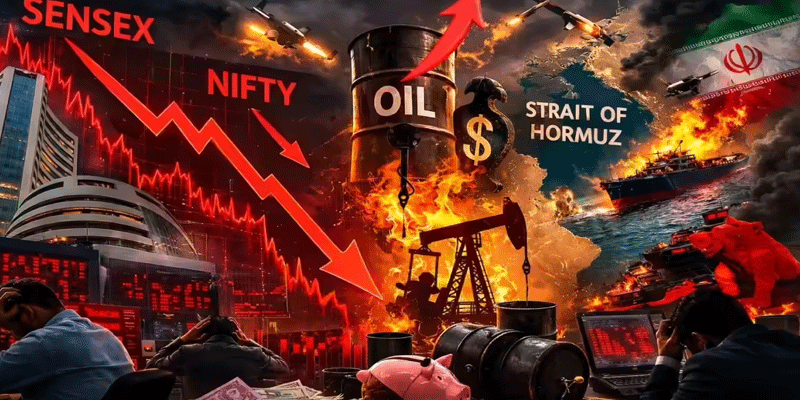
By firmly rejecting the allegation regarding US naval access to its ports, New Delhi is attempting to preserve this delicate balance. Any escalation in the conflict could disrupt oil markets and shipping lanes critical to India’s economy, while also raising concerns about regional instability affecting South Asia.
Navigating Neutrality in a Turbulent Region
As the US-Israel-Iran confrontation intensifies, countries outside the immediate conflict zone are being forced to clarify their positions. India’s swift denial of involvement in US military logistics reflects a deliberate strategy: maintain partnerships without compromising strategic independence.
In an increasingly polarized global environment, misinformation can easily inflame diplomatic tensions. By publicly refuting the claims and reaffirming its neutral stance, New Delhi has sought to prevent unnecessary friction while continuing to monitor a rapidly evolving crisis that could reshape the geopolitical balance of the Middle East and beyond.
(With agency inputs)