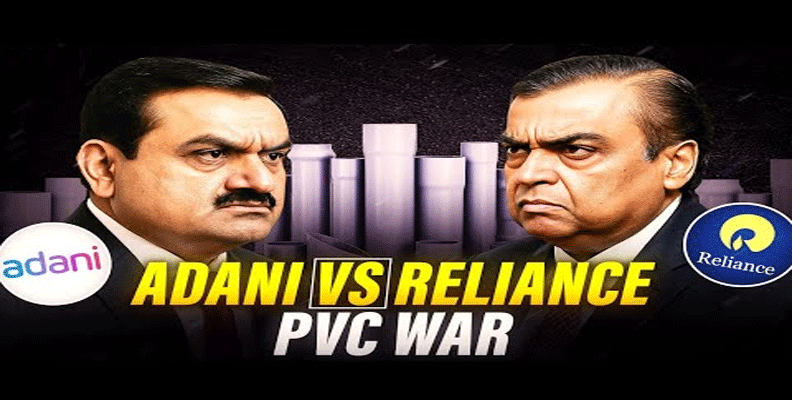
Adani Group’s move into PVC is more than diversification—it represents an attempt to convert India’s large polymer deficit into another infrastructure-scale business. Through Mundra Petrochem Limited, Adani Enterprises is developing a phased 2 million tonnes-per-annum PVC complex at Mundra, Gujarat, beginning with 1 MTPA. Importantly, Adani’s current disclosure says Phase 1 is targeted for full commissioning in FY2027-28, rather than December 2026.
The opportunity is substantial. India consumed around 4.55 million tonnes of PVC in FY2025-26, against domestic capacity of only about 1.6 million tonnes. Imports therefore fill much of the gap. Adani estimates India's PVC market is expanding at roughly 7–8% annually, driven particularly by agriculture, construction, infrastructure and water management.
This is where Adani’s existing infrastructure becomes strategically important. Mundra provides proximity to one of India’s largest ports, while the wider group brings capabilities across logistics, resources and energy. Adani specifically identifies these synergies and lower logistics costs as advantages for the PVC project.
Reliance, however, enters this competition from a very different position. It already operates an enormous integrated oil-to-chemicals platform and produced 0.8 MMT of PVC, 3.1 MMT of polypropylene and 2.3 MMT of polyethylene for sale during FY2025-26. Its petrochemical manufacturing footprint includes Jamnagar, Hazira, Dahej, Vadodara and Nagothane.
| Competitive area | Reliance Industries | Adani Enterprises |
|---|---|---|
| Market position | Established integrated petrochemical producer | Large-scale new entrant in PVC |
| PVC | Existing production; 0.8 MMT production meant for sale in FY26 | 1 MTPA Phase 1; expandable to 2 MTPA |
| Polymer portfolio | PVC, PE, PP, PET and specialty materials | Initial focus on PVC |
| Manufacturing advantage | Integrated refining and petrochemical ecosystem | Mundra port, logistics, resources and energy ecosystem |
| Expansion | Major PVC/CPVC capacity additions underway | Building greenfield Mundra PVC platform |
| Strategic opportunity | Defend and expand established leadership | Capture import substitution and domestic demand |
Reliance is not standing still. It is expanding PVC/CPVC capacity, including a 1.2-million-tonne PVC plant at Nagothane, while its broader strategy extends into specialty polyester and carbon fibre. That means Adani will encounter an incumbent with scale, feedstock integration, manufacturing experience, customer relationships and an extensive polymer portfolio.
The emerging competition is therefore bigger than Adani versus Reliance in plastic. Reliance built a powerful model around refining → petrochemicals → polymers → advanced materials. Adani is attempting another integrated model: port → imported resources/feedstock → energy → PVC manufacturing → logistics → Indian infrastructure demand. If execution follows its planned scale, Adani could introduce significant new competition into India's PVC market while helping substitute imports. With Reliance simultaneously expanding, India could ultimately be the bigger beneficiary—through additional domestic capacity, supply resilience and greater competition