Intelligence Veteran to Lead Policing in the National Capital
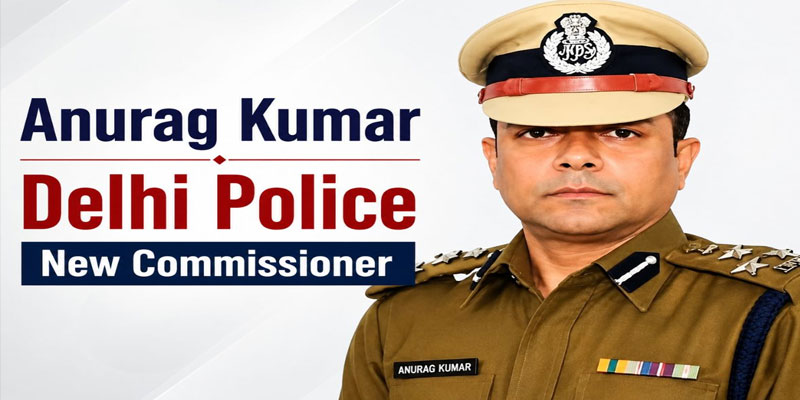
The Centre has appointed Anurag Kumar as the new Commissioner of Delhi Police, replacing Satish Golcha in a significant leadership change at the helm of one of India's most sensitive police forces. A seasoned Indian Police Service (IPS) officer with extensive experience in both policing and intelligence, Kumar's appointment signals the government's preference for a security-focused administrator to lead law enforcement in the national capital. His long association with the Intelligence Bureau (IB) is expected to strengthen the integration of intelligence gathering and operational policing at a time when Delhi continues to face complex security, law-and-order and cyber challenges.
A Career Spanning Policing and Intelligence
A 1994-batch IPS officer of the AGMUT cadre, Anurag Kumar brings nearly 32 years of professional experience across field policing, administration and national security. An engineer by academic training, he began his career in conventional policing before serving as Deputy Commissioner of Police (DCP) in several districts of Delhi. These assignments provided him with extensive exposure to the capital's crime patterns, communal sensitivities and urban policing requirements.
Around two decades ago, Kumar moved to the Intelligence Bureau, where he gradually built expertise in internal security, counter-terrorism and strategic intelligence operations. His long tenure within India's premier domestic intelligence agency has given him a deep understanding of national security challenges and the strategic importance of Delhi as the country's political and administrative centre.
Leadership Role in the Intelligence Bureau
Before his appointment as Delhi Police Commissioner, Kumar served as Special Director of the Intelligence Bureau, one of the agency's senior-most positions.
In this capacity, he played a key role in intelligence coordination involving terrorism, insurgency, espionage and other internal security threats. He was also involved in analysing intelligence inputs, coordinating operational responses and contributing to national security assessments across multiple domains.
His nearly 20-year association with the Intelligence Bureau distinguishes him from many of his predecessors, positioning him as an officer whose expertise extends well beyond conventional policing into the broader architecture of India's internal security.
A Significant Leadership Transition
The Appointments Committee of the Cabinet, headed by Prime Minister Narendra Modi, approved Kumar's repatriation from the Intelligence Bureau to his parent AGMUT cadre before appointing him as Delhi Police Commissioner through a Ministry of Home Affairs order.
He succeeds Satish Golcha, a 1992-batch IPS officer who had served as Commissioner since August 2025 and has now been directed to report to the Lieutenant Governor. The transition reflects an important administrative decision rather than a routine transfer, given Delhi Police's critical role in safeguarding the national capital, protecting constitutional institutions, ensuring VIP security and managing politically sensitive events.
Why the Appointment Matters
Kumar's elevation underscores an increasing convergence between intelligence-led security management and urban policing. Delhi hosts Parliament, the Supreme Court, foreign diplomatic missions, major government institutions and numerous high-profile public events, making it one of the country's most security-sensitive cities.
His intelligence background is expected to enhance coordination between central agencies and local police, particularly in areas such as counter-terrorism, preventive intelligence, surveillance and early threat detection. At the same time, the appointment also reflects the Centre's emphasis on strengthening preparedness against emerging challenges, including cybercrime, organised crime and large-scale public demonstrations.
Balancing Security with Public Trust
While Kumar's intelligence experience equips him to anticipate and respond to complex security threats, his tenure will also require effective public-facing policing. Managing protests, communal tensions, cyber-enabled offences and routine law-and-order issues demands not only operational efficiency but also transparency, accountability and public confidence.
His challenge will be to balance preventive security measures with democratic policing standards in a city where law enforcement frequently operates under intense public and political scrutiny. If he successfully integrates intelligence capabilities with responsive community policing, Anurag Kumar could help shape a more proactive and resilient policing model for the national capital. His appointment therefore marks not just a change in leadership, but a strategic shift towards intelligence-driven urban security in one of India's most complex policing environments.
(With agency inputs)