Aryan Gupta Tops as Over 11 Lakh Qualify
The National Testing Agency (NTA) has declared the results of the NEET-UG 2026 re-examination, with Aryan Gupta securing All India Rank (AIR) 1. The results bring closure to one of the most closely watched medical entrance examination cycles in recent years, with over 11.21 lakh candidates qualifying for undergraduate medical programmes. A notable feature of this year's outcome is the strong performance of female candidates, who not only outnumbered men among successful aspirants but also recorded a higher qualification rate, reflecting an evolving trend in India's medical education landscape.
A Re-Examination to Restore Credibility
The NEET-UG 2026 admission cycle was overshadowed by allegations of examination irregularities, including reports of a paper leak, prompting the NTA to conduct a re-test to safeguard the integrity of the country's largest medical entrance examination.
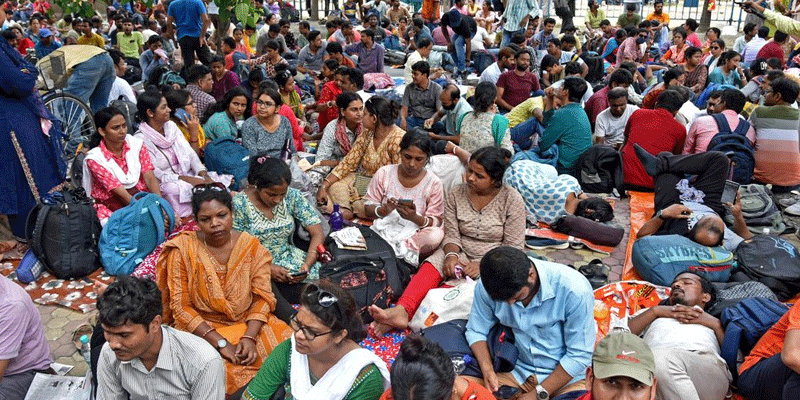
The re-examination was organised with the twin objectives of ensuring fairness and maintaining the academic calendar for admissions to MBBS, BDS, AYUSH and other undergraduate health science programmes. Of the 22.79 lakh registered candidates, nearly 20 lakh appeared for the examination, with 11.21 lakh ultimately qualifying for the counselling process. By releasing the results on schedule, the NTA has sought to reassure students and institutions that the admission process can proceed without significant disruption despite the challenges faced during the examination cycle.
Top Performers Reflect Intense Competition
Aryan Gupta from Punjab emerged as the overall topper by scoring 715 out of 720 marks. Haryana's Panshul Bansal also secured 715 marks, placing him at AIR 2, while Uplakshya Goyal claimed AIR 3, underscoring the exceptionally narrow margin separating the highest-ranked candidates.
Among female candidates, Kudale Shravani Krishna, who secured AIR 5, emerged as the highest-ranked woman in the re-examination. The close clustering of near-perfect scores once again highlights the intense competition for admission into India's premier medical colleges, where even a single mark can significantly influence national rankings and institutional preferences.
Female Candidates Continue to Set the Pace
One of the most significant outcomes of the NEET-UG 2026 re-exam is the continued rise of women in medical education. More than 58 per cent of all qualified candidates are women, making them the clear majority among successful aspirants.
The qualification data also reveal that 56.8 per cent of female candidates who appeared cleared the examination, compared with 55.1 per cent of male candidates. While the numerical difference may appear modest, it reflects a consistent pattern of increasing female participation and academic success in competitive medical entrance examinations.
This trend is expected to shape the future composition of India's healthcare workforce as more women enter medical colleges and subsequently join the country's expanding network of healthcare institutions.
Implications for Examination Governance and Medical Education
The successful conduct of a nationwide re-test involving nearly 20 lakh candidates demonstrates the logistical capacity of India's examination system while also highlighting the immense pressure on institutions to maintain credibility after allegations of malpractice.
At the same time, the concentration of top scores near the maximum possible marks raises broader questions about score differentiation in highly competitive entrance examinations. As increasing numbers of candidates achieve exceptionally high scores, policymakers may eventually need to explore more effective methods of distinguishing among top-performing students for admissions to elite institutions.
A Test of Both Resilience and Reform
The declaration of the NEET-UG 2026 re-examination results marks more than the conclusion of a disrupted admission cycle. It reflects the resilience of India's examination system, the determination of millions of aspirants and the growing aspirations of a new generation of medical professionals.
While the re-test has helped restore confidence in the admission process, the episode also underscores the need for stronger examination security, greater institutional transparency and continued reforms to protect the credibility of high-stakes national assessments. Equally significant is the continued rise of women among successful candidates, signalling a gradual transformation of India's future medical workforce and reinforcing the country's expanding pool of healthcare talent.
(With agency inputs)