Government Rejects Claims Of “Slow Encroachment”
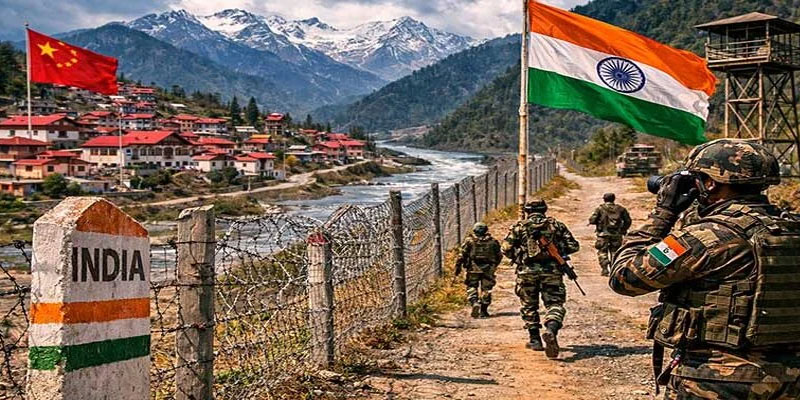
Fresh claims that China is allegedly carrying out a “slow encroachment” into Arunachal Pradesh have been rejected by government sources, who described the social-media allegations as “attention-seeking ploys” unsupported by specific evidence. The official position is that there is no systematic Chinese intrusion into Indian territory, although certain stretches of the India-China boundary remain undemarcated and can witness face-to-face patrols.
An Old Boundary Dispute with New Pressures
The controversy needs to be viewed against the unresolved India-China boundary dispute. Arunachal Pradesh has long been claimed by Beijing, which refers to the region as “Zangnan” or “South Tibet.” China rejects the 1914 Simla Convention and the McMahon Line, the basis for India’s position on the eastern sector, arguing that Tibet lacked the authority to conclude such an agreement.
Beijing’s territorial claims have persisted despite repeated diplomatic exchanges. Over recent years, the dispute has also acquired a cartographic dimension, with China assigning Chinese names to locations in Arunachal Pradesh and objecting to Indian infrastructure and official visits there.
Undemarcated Does Not Mean Lost Territory
The government’s response rests on an important distinction: an undefined portion of the Line of Actual Control (LAC) can generate competing perceptions without automatically indicating that territory has changed hands.
According to official sources, the Indian Army and Indo-Tibetan Border Police remain equipped to monitor and dominate the frontier. When patrols encounter each other in areas where perceptions of the LAC differ, such encounters are managed through established military and diplomatic mechanisms, including commander-level meetings and the Working Mechanism for Consultation and Coordination on India-China border affairs.
Recent reports concerning the remote Taksing area of Upper Subansiri district had fuelled speculation after social-media accounts alleged that Chinese troops had established positions inside Indian territory. However, there has been no official confirmation of a new Chinese intrusion.
China’s “Map War” Keeps Sovereignty in Focus
China’s approach has increasingly extended beyond physical border activity. Renaming places in Arunachal Pradesh and repeatedly asserting sovereignty over the region forms part of what analysts describe as a broader “map war”, aimed at reinforcing Beijing’s territorial narrative.
India has responded by maintaining official Indian names for Arunachal locations and strengthening infrastructure and administrative presence near the frontier. The contest is therefore not merely military; it is also diplomatic, cartographic and psychological.
Infrastructure Raises the Strategic Stakes
The latest denial comes as India continues improving roads, airfields, communications and forward logistics across the northeastern frontier. These projects are designed to reduce the logistical disadvantage that historically affected Indian deployments in difficult mountainous terrain.
At the same time, New Delhi remains conscious that sustained border tension can influence the wider bilateral relationship. India has repeatedly maintained that peace and tranquillity along the LAC are essential for stable India-China relations.
Vigilance Must Rise Without Feeding Rumours
The government’s rejection of “slow encroachment” claims does not mean the Arunachal frontier is free of risk. Undemarcated stretches, competing territorial perceptions and China’s persistent sovereignty claims demand constant surveillance and preparedness. But separating verified developments from sensational social-media narratives is equally important. India’s strongest response lies in credible intelligence, sustained border presence, faster infrastructure development and firm diplomacy—not unsubstantiated alarm.
(With agency inputs)