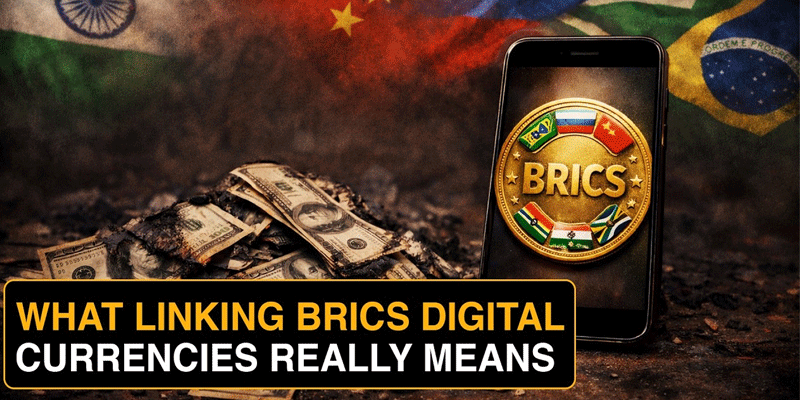
As India prepares to host the BRICS summit in New Delhi, de-dollarisation is again drawing attention, but the discussion is more nuanced than talk of creating a common BRICS currency. The focus is increasingly on local-currency trade, interoperable payment systems and alternative settlement mechanisms. India, however, is seeking greater financial flexibility without turning BRICS into an anti-dollar alliance.
BRICS’ Evolving Financial Agenda
The bloc’s approach has gradually shifted from political rhetoric towards practical financial cooperation. The 2025 Rio declaration supported financing mechanisms in local currencies and called for greater interoperability among BRICS payment systems. It also backed work on faster, cheaper and safer cross-border payments.
The emerging objective is therefore not necessarily to replace the dollar, but to give member countries more choices in conducting trade and settling payments. The proposed BRICS financial architecture remains voluntary and technically oriented rather than a formal challenge to the existing global monetary system.
What’s India’s Stand on De-Dollarisation?
India's position is distinctly pragmatic. New Delhi supports reducing excessive dependence on any single currency and encourages the use of the rupee and other national currencies where commercially practical. But it has repeatedly rejected the idea that India is pursuing a campaign to replace the US dollar.
External Affairs Minister S. Jaishankar has explicitly said India has no policy to replace the dollar, while noting that the currency continues to contribute to global economic stability. He has also pointed out that BRICS itself does not have a unified position on de-dollarisation.
India's preferred route is therefore rupee internationalisation rather than dollar confrontation. The objective is to make the rupee more useful in international trade, expand bilateral settlement arrangements and reduce transaction costs, particularly with countries facing shortages of hard currencies.
Payments Could Matter More Than Currency
India's BRICS strategy is also increasingly focused on digital financial connectivity. BRICS members have been discussing the potential interlinking of fast-payment systems and central-bank digital currencies to make cross-border transactions cheaper and more efficient.
This approach fits India's experience with UPI and its broader effort to build interoperable digital payment infrastructure. The 2025 BRICS declaration specifically supported exploring greater interoperability of member payment systems.
China and Russia Want Greater Flexibility
China remains interested in expanding the international role of the renminbi and increasing yuan-based settlements. Russia has an even stronger practical incentive to diversify payment channels because of Western sanctions. Yet Moscow itself has recently clarified that it does not seek de-dollarisation as an objective in itself and remains open to acceptable payment methods.
These differences underline the challenge for BRICS: its members share an interest in greater financial autonomy, but not necessarily a common monetary strategy.
India’s Strategic Middle Path
For India, the emerging BRICS model is best described as “more options, not less dollar.” New Delhi wants resilient payment systems, wider rupee usage and stronger local-currency financing while preserving economic stability and strategic flexibility.
The Bigger Picture: Reform Without Financial Fragmentation
BRICS is unlikely to abandon the dollar overnight—or create a common currency anytime soon. Its more realistic transformation lies in building parallel mechanisms that allow members to trade, invest and settle payments more efficiently. For India, that means strengthening financial sovereignty without closing the door to the dollar or Western economic partnerships. The goal is not to dethrone the dollar, but to ensure that no single currency becomes the only available route to global commerce.
(With agency inputs)