A Warning Wrapped in a Nuclear Claim
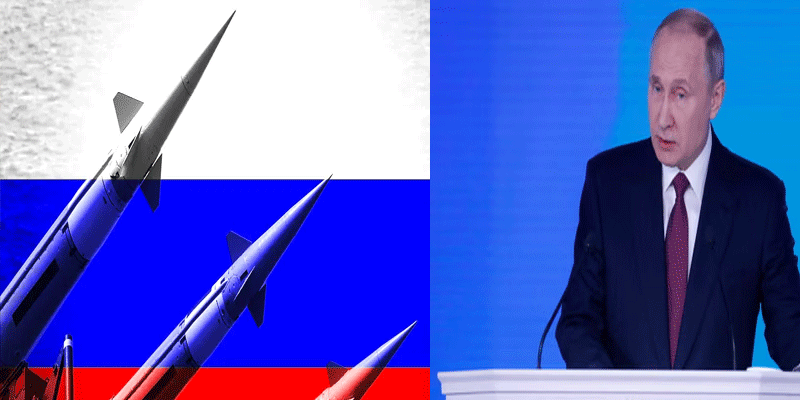
Russia’s assertion that Japan could assemble nuclear weapons within a year has reignited debate over Tokyo’s latent nuclear capability and the rapidly changing security environment in East Asia. Russian presidential aide Anton Kobyakov made the claim to TASS on August 25, linking it to what Moscow describes as Japan’s accelerating militarisation and deeper alignment with the United States.
Yet the statement should be treated primarily as a geopolitical warning rather than independently verified evidence of an imminent Japanese nuclear breakout. Japan possesses sophisticated civilian nuclear capabilities, but technical potential and political intent are fundamentally different questions.
Why Moscow Is Raising the Alarm
Kobyakov’s argument comes against the backdrop of Japan’s expanding defence cooperation with Washington and growing concerns over China, North Korea and Russia. By portraying Japan as a potential nuclear threshold state, Moscow is seeking to frame Tokyo’s conventional military expansion as destabilising rather than defensive.
The timing is significant. Japan and the United States held their latest Extended Deterrence Dialogue in June, where Washington reaffirmed that its commitment to Japan includes the full range of US defence capabilities, including nuclear forces. The two sides also discussed nuclear and missile threats, arms control and strategic stability.
Japan Has Capability, But Capability Isn’t Intent
Russia’s claim gains some credibility from Japan’s extraordinary nuclear infrastructure. Japan’s Atomic Energy Commission estimates its separated-plutonium stockpile at about 44.4 tonnes at the end of fiscal 2025, although much of it is held overseas.
Japan also possesses advanced scientific expertise, nuclear engineering capacity and sophisticated industrial and technological infrastructure. These characteristics have long led analysts to describe Japan as a country with significant latent nuclear potential.
But this does not mean Japan has decided to build nuclear weapons. Moving from civilian capability to an operational arsenal would involve political authorisation, major policy changes, weapons development, delivery systems, command-and-control arrangements and potentially a fundamental rupture with Japan’s existing international commitments. A one-year estimate therefore compresses numerous complicated stages into a single political assertion.
The Legal and Strategic Barriers
Japan's post-war nuclear policy remains anchored in the Three Non-Nuclear Principles—not possessing, producing or permitting the introduction of nuclear weapons. Tokyo continues to maintain the US alliance and extended nuclear deterrence as the foundation of its security policy.
Its nuclear activities are also subject to international safeguards. The International Atomic Energy Agency’s safeguards framework is designed to detect diversion of declared nuclear material and undeclared nuclear activity. Any Japanese move towards weaponization would therefore carry major diplomatic and economic consequences and would be extremely difficult to conceal.
The Bigger Asian Security Equation
The more immediate development is Japan strengthening its conventional deterrence while relying on the US nuclear umbrella. The June 2026 dialogue reaffirmed Washington’s extended-deterrence commitment and highlighted concerns over China’s nuclear expansion and North Korea’s nuclear programme.
That environment nevertheless keeps Japan’s nuclear debate alive. North Korea’s missile capabilities, China’s expanding arsenal and intensifying US-China rivalry create pressures that could gradually alter Japanese strategic calculations.
Capability Must Not Be Mistaken for Intent
Russia’s warning matters because it highlights a genuine strategic possibility, but not an established Japanese decision. Japan has the technological foundation to shorten the path to nuclear capability; available official evidence does not show that Tokyo has chosen that path.
The distinction is vital. Treating latent capability as imminent weaponisation risks exaggerating regional threats and deepening the very arms competition that makes East Asia unstable. Japan’s choices will ultimately depend not only on technology, but on domestic politics, public opinion, alliance guarantees and the evolving regional threat environment. For now, Russia’s statement is best understood as a warning designed to influence the Asian security debate—not proof that Japan is preparing to become a nuclear-armed state.
(With agency inputs)