A New Defence Link with Kuwait
Pakistan’s latest defence agreement with Kuwait marks another step in Islamabad’s expanding security footprint across the Gulf, but it does not presently amount to a direct military threat to India. The “Protocol Agreement-2026”, signed in Islamabad by Kuwaiti Defence Minister Sheikh Abdullah Ali Abdullah Al-Salem Al-Sabah and Pakistan’s Defence Minister Khawaja Muhammad Asif, focuses on operational coordination, expertise-sharing, training and military readiness.
The agreement expands a 2023 defence cooperation framework rather than creating a mutual-defence alliance. There is no publicly confirmed provision for Kuwaiti military intervention in an India-Pakistan conflict, Pakistani basing rights in Kuwait or a new weapons-transfer arrangement.
Why Pakistan’s Gulf Role Is Expanding
The agreement nevertheless carries strategic significance because it comes as Gulf states reassess their security requirements amid heightened regional instability. Kuwait can benefit from Pakistan’s military experience in areas including training, border management and capacity-building, while Islamabad gains another institutional relationship with an important Gulf state.
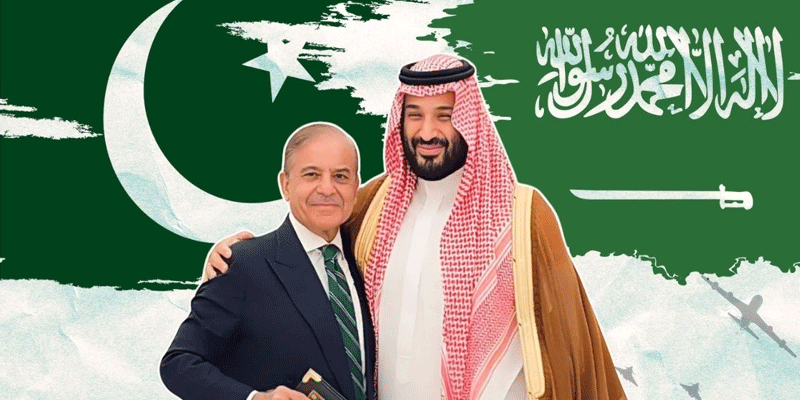
The development also follows the August 7 Mecca Joint Defence Agreement between Pakistan, Saudi Arabia and Türkiye, which introduced a collective-deterrence commitment. Although its operational arrangements remain unclear, that agreement has given Pakistan greater visibility within Gulf security calculations.
Kuwait, however, should not automatically be viewed as part of that emerging security arrangement. Its latest protocol remains a bilateral extension of existing defence cooperation, rather than evidence of a unified Pakistan-led Gulf military bloc.
Is Islamabad’s Expanding Footprint A Worry to India?
For India, the concern is principally strategic and indirect. If Pakistan’s Gulf partnerships deepen, they could eventually provide greater access to defence contracts, military training, technology, intelligence networks and financial resources. Stronger political relationships could also give Islamabad additional diplomatic space during a future India-Pakistan crisis.
But there is an important counterpoint: Gulf countries are simultaneously strengthening their defence relationships with India. The UAE and India have been advancing a strategic defence partnership, Oman remains an important Indian maritime partner with access at Duqm, while India and Kuwait elevated bilateral ties to a strategic partnership in 2024.
This demonstrates that Gulf capitals are pursuing diversified security relationships rather than simply choosing between New Delhi and Islamabad. Their calculations are driven primarily by national security, economic interests, energy security and regional stability.
What New Delhi Should Watch Closely
India’s immediate response should therefore be measured rather than alarmist. The key issue is implementation. Training and border-management cooperation pose limited strategic concerns; intelligence-sharing, sophisticated arms transfers, military interoperability or arrangements enabling Pakistani force projection would carry considerably greater implications.
New Delhi should consequently strengthen defence and maritime engagement with Kuwait and other Gulf partners while closely monitoring Pakistan’s evolving military relationships. Protecting India’s energy supplies, trade routes and the interests of its large Gulf-based community should remain central to this strategy.
Watch The Evolution, Not Just the Agreement
Pakistan’s Kuwait pact is undoubtedly a diplomatic and military gain for Islamabad, particularly at a time when Gulf security is becoming more interconnected and contested. But it would be premature to interpret it as an anti-India alliance.
For New Delhi, the right response is vigilance without overreaction. The real strategic significance of Pakistan’s Gulf push will emerge not from the signing ceremony, but from what follows—whether these partnerships remain centred on training and capacity-building or evolve into deeper intelligence, weapons and operational cooperation.
(With agency inputs)