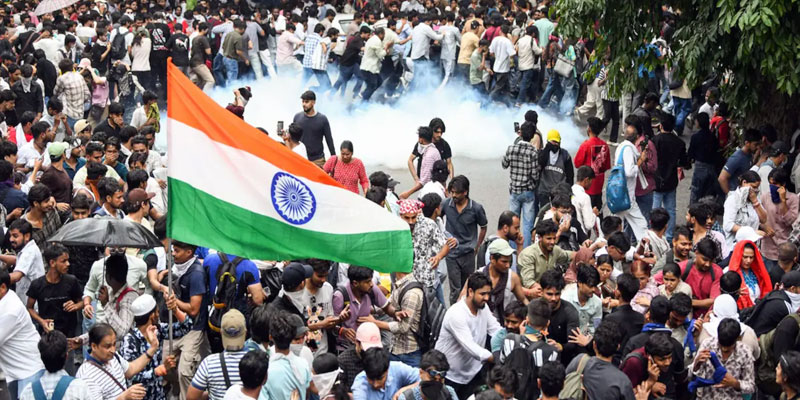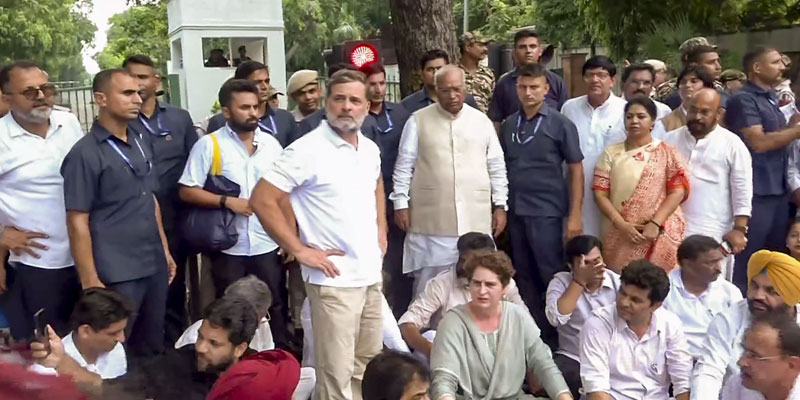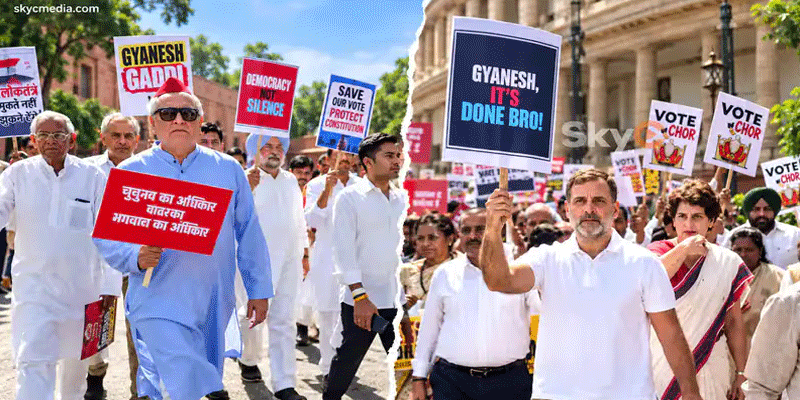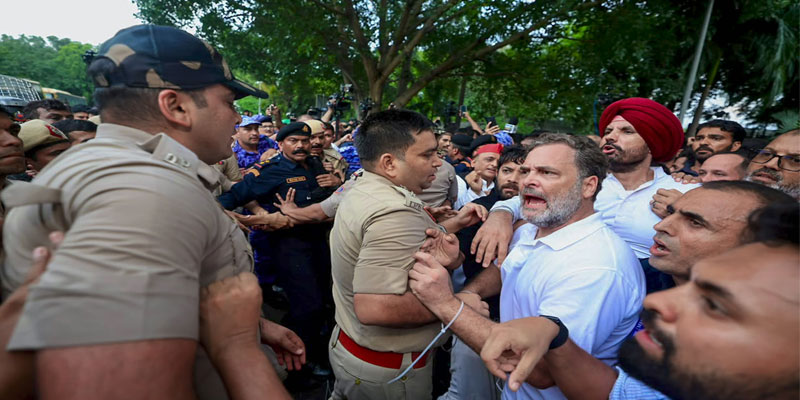
Congress Leader of Opposition Rahul Gandhi’s decision to stage a dharna outside Delhi’s Parliament Street Police Station has transformed an alleged episode of police excess into a larger political and accountability controversy. Gandhi accompanied 19-year-old protester Sahil Lochab, who claims he suffered pellet injuries during the July 20 “Chalo Sansad” march, first to Mandir Marg Police Station and later to the Parliament Street police complex. He demanded an FIR, details of the police inquiry and clarity on action taken so far. Police subsequently indicated that the complaint had been accepted, although questions over its precise legal status remained contentious.
From NEET Protest to Political Flashpoint
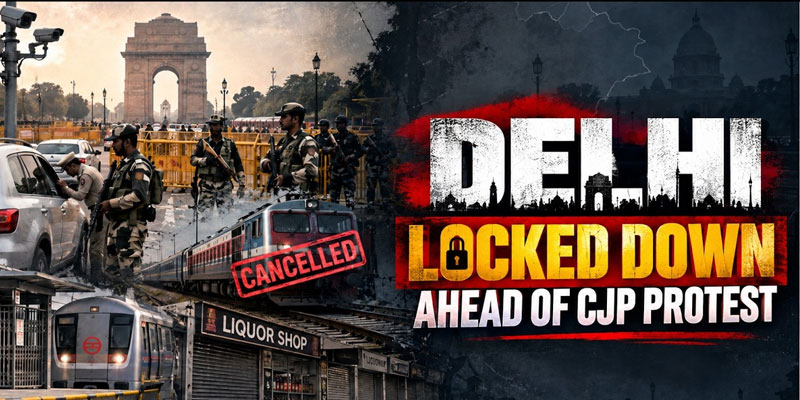
The controversy originated in a student-led demonstration by the Cockroach Janta Party against alleged irregularities in the NEET system and demanding the resignation of then Education Minister Dharmendra Pradhan. Protesters attempting to march from Jantar Mantar towards Parliament on July 20 were stopped by police, who described the gathering as unauthorised and said barricades were breached.
Authorities maintained that force was necessary to prevent escalation and a possible stampede. A Delhi Police affidavit before the Supreme Court reportedly said more than 240 personnel were injured, alongside around 200 protesters or members of the public.
The Unresolved Pellet-Firing Question
The central dispute concerns allegations that pellet guns were used against demonstrators. Delhi Police has denied firing pellets, maintaining that such weapons are not part of its armoury and that conventional crowd-control measures were deployed.
However, scrutiny has extended to the Rapid Action Force, a CRPF unit deployed for riot-control duties. Reports citing internal records have indicated that seven rounds were fired during the protest, with five allegedly striking protesters. General-diary entries and RTI responses have also reportedly referred to anti-riot-gun use and pellet-related injuries.
These competing accounts make an independent fact-finding exercise essential. The key issue is not merely whether force was used, but whether the force, ammunition and methods employed were lawful and proportionate to the circumstances.
Why Rahul Gandhi Entered the Fray
Gandhi’s intervention carries significance on several levels.
· First, it gives national visibility to a young protester who says repeated attempts to register his complaint produced no effective response.
· Second, Congress can frame the controversy around the constitutional right to peaceful dissent, student rights and police accountability.
· Third, staging the protest outside Parliament Street Police Station places direct political pressure on the Delhi Police and, indirectly, the Union Home Ministry.
The location itself reinforces Congress’s argument that accountability should not disappear behind institutional procedures.
The Questions That Demand Answers
Acceptance of the complaint may ease the immediate confrontation, but it does not settle the larger issues. A credible investigation must establish who authorised the use of force, what ammunition was deployed, whether warnings and graduated crowd-control procedures were followed, and whether the response was proportionate.
Medical records, deployment logs, police communications, CCTV footage and projectiles or other forensic evidence should be examined independently.
Beyond Politics, Truth Must Prevail
Rahul Gandhi’s dharna has elevated a student protest into a national debate over dissent and executive accountability. Political parties will naturally interpret the episode through competing narratives, but the institutional test is more fundamental. The credibility of the police, the government and the opposition will ultimately depend on whether the events of July 20 are established through transparent, evidence-based scrutiny. In a democracy, accountability cannot rest on competing claims; it must rest on verifiable facts.
(With agency inputs)