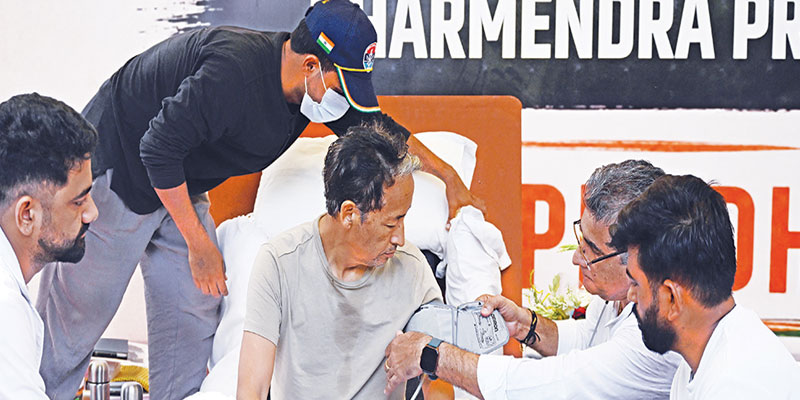
Police Remove Sonam Wangchuk on Medical Grounds
Activist Sonam Wangchuk was removed from his hunger-strike tent at Jantar Mantar by Delhi Police in the early hours of Saturday on medical grounds, with authorities citing his deteriorating health and compliance with directions issued by the Delhi High Court. He was shifted to Safdarjung Hospital for treatment in a carefully coordinated operation that was largely shielded from public view. The move has triggered fresh political confrontation, with protest organisers accusing the administration of using medical intervention to dismantle the agitation.
Hunger Strike Over Examination Reforms
The Ladakh-based engineer and climate activist joined the Cockroach Janta Party (CJP)-led protest at Jantar Mantar on June 28 and began an indefinite hunger strike demanding accountability over examination irregularities, particularly the NEET paper leak. The protesters also sought Union Education Minister Dharmendra Pradhan's resignation and comprehensive reforms to India's examination system.
The agitation gradually expanded beyond examination reforms, drawing support from farmer leader Rakesh Tikait, AAP chief Arvind Kejriwal, opposition leaders and hundreds of farmers. By July 16-17, Wangchuk had completed more than 20 days of fasting, with visible signs of physical deterioration despite regular medical monitoring.
The Removal Operation and Official Justification
Before dawn, Delhi Police executed a tightly planned operation involving personnel in civilian clothes, supported by paramedics. According to protest organisers, white sheets and curtains were erected around Wangchuk's tent to block visibility, while uniformed police secured the outer perimeter and restricted media and protester access as he was shifted on a stretcher.
Police described the operation as a restrained, medically necessary intervention carried out in accordance with the Delhi High Court's direction to monitor Wangchuk's health and provide treatment whenever required. Officials maintained that protecting his life took precedence once doctors assessed his condition as potentially risky.
Legal and Political Contestation
The administration has presented the hospitalisation as a welfare-driven action backed by medical advice and judicial oversight. However, CJP leaders and several opposition figures have rejected that interpretation, arguing that while the court sought to safeguard Wangchuk's health, it did not authorise the covert dismantling of a peaceful protest.
The manner of the operation, particularly the use of civilian-clothed personnel and visual barriers, has intensified allegations of opacity and excessive state intervention, adding another layer to the ongoing political confrontation.
Hospitalisation, Consent and Protest Continuity
Wangchuk was admitted to Safdarjung Hospital, where doctors have stated that he remains conscious, stable and under observation. His wife, Gitanjali Angmo, has insisted that no oral or intravenous treatment should be administered without the consent of the family and the doctors who had supervised his fast, raising questions over the autonomy of hunger strikers.
In response to his removal, CJP founder Abhijeet Dipke launched an indefinite hunger strike at Jantar Mantar, vowing to continue the agitation and proceed with the proposed July 20 march. The leadership transition reflects the movement's attempt to sustain both its momentum and moral appeal despite Wangchuk's hospitalisation.
A Defining Test for Democratic Dissent
As of July 18, Wangchuk remains under medical supervision while Jantar Mantar continues to witness heavy police deployment. The episode highlights three broader issues: the challenge of balancing public safety with the right to protest, the growing crisis of public trust in examination governance, and the evolving nature of protest leadership.
The operation demonstrates a governance model that relies on legally defensible and medically justified interventions, yet risks fuelling perceptions of secrecy and coercion. Consequently, the controversy now extends beyond Wangchuk's hunger strike, raising larger questions about institutional accountability, democratic freedoms and the state's approach to managing high-profile public dissent.
(With agency inputs)