A Successful Lift-off
NASA’s SpaceX Crew-12 mission has successfully launched, sending the Dragon spacecraft into orbit on a journey to the International Space Station (ISS). The mission lifted off from Kennedy Space Center’s historic launch complex, marking another milestone for the commercial crew programme that has reshaped human spaceflight logistics over the past decade. The Falcon 9 rocket’s booster returned safely to its landing zone, highlighting the growing reliability of reusable launch technology and reinforcing confidence in cost-efficient access to orbit.
The Crew-12 flight represents the next rotational expedition to the ISS and continues a sustained multinational effort to maintain scientific operations aboard the orbital laboratory.
Mission Objectives and Operational Goals
The central objective of Crew-12 is to support long-duration research and station maintenance during an approximately eight-month stay in orbit. The crew will conduct hundreds of experiments across biotechnology, materials science, Earth observation and human-health research. These investigations are designed to generate insights relevant not only to life aboard the ISS but also to future lunar and Mars missions.
Operationally, the mission will test advanced spacecraft systems, refine autonomous docking procedures and support ongoing station upgrades. The mission also sustains collaboration between international space agencies at a time when the ISS remains one of the few arenas for continued global scientific cooperation in orbit.
Crew Composition and Background
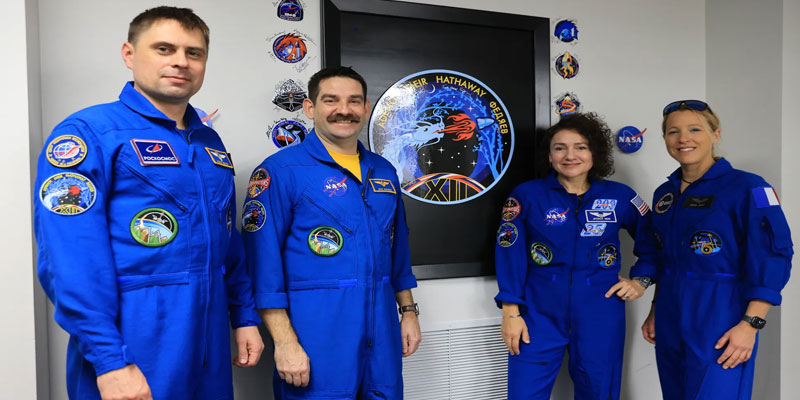
The four-member crew reflects the collaborative nature of modern human spaceflight. NASA astronaut Jessica Meir serves as commander, bringing prior flight experience and expertise in physiology and spacewalking. Pilot Jack Hathaway, a first-time space traveller, is responsible for spacecraft operations and navigation during key phases of the mission. Representing the European Space Agency, Sophie Adenot joins as a mission specialist, focusing on robotics and Earth-observation research. Russian cosmonaut Andrey Fedyaev completes the crew, contributing engineering and systems knowledge drawn from earlier space missions.
This international composition underscores the continued partnership between NASA, the European Space Agency and Roscosmos, even amid shifting geopolitical dynamics on Earth.
Key Microgravity Experiments
A major component of Crew-12’s work will involve research into the effects of microgravity on the human body. One flagship study examines fluid redistribution in orbit, where blood and other fluids shift toward the head in weightlessness. By monitoring circulation and cardiovascular responses, researchers hope to better understand risks such as clot formation during long missions.
Another experiment focuses on manual piloting performance across changing gravity environments. Astronauts will simulate spacecraft landings to assess how extended exposure to microgravity affects coordination, spatial awareness and decision-making—data that will be critical for future lunar surface operations.
Vision and neurological health are also under investigation through studies on spaceflight-associated neuro-ocular syndrome. These experiments monitor changes in eyesight and intracranial pressure, aiming to develop countermeasures for long-duration missions to the Moon and Mars. Additional research includes studies on microbial behaviour, crop growth in space and advanced material manufacturing processes that benefit from the absence of gravity.
Strategic Significance
Crew-12 highlights the growing synergy between NASA and private industry, with reusable spacecraft reducing costs and enabling more frequent missions. The flight also supports the transition toward future commercial space stations, ensuring that scientific output remains robust during this period of change.
Sustaining Science Beyond Earth
The successful launch of Crew-12 reinforces the continuity of human presence aboard the ISS and advances preparations for deeper space exploration. By combining international expertise with cutting-edge research, the mission strengthens scientific understanding of life in microgravity and helps refine technologies needed for long-duration space travel. As the crew begins months of experiments in orbit, their work will contribute to the broader effort to extend human exploration beyond low-Earth orbit while maintaining a strong foundation of global cooperation in space.
(With agency inputs)