A Landmark in India’s Automotive Journey
In a defining moment for India’s manufacturing and green mobility aspirations, Prime Minister Narendra Modi on Tuesday launched Maruti Suzuki’s e Vitara, the company’s first global battery electric vehicle (BEV). The event, held at Hansalpur in Gujarat, also marked the start of localized hybrid battery electrode production, a crucial step in reducing dependence on imports and strengthening India’s energy ecosystem.
This development is not only a milestone for Suzuki and its partners but also a bold statement of India’s intent to emerge as a global hub for electric vehicles (EVs) under the banner of Make in India, Make for the World.
Modi’s Call for Swadeshi and Green Mobility
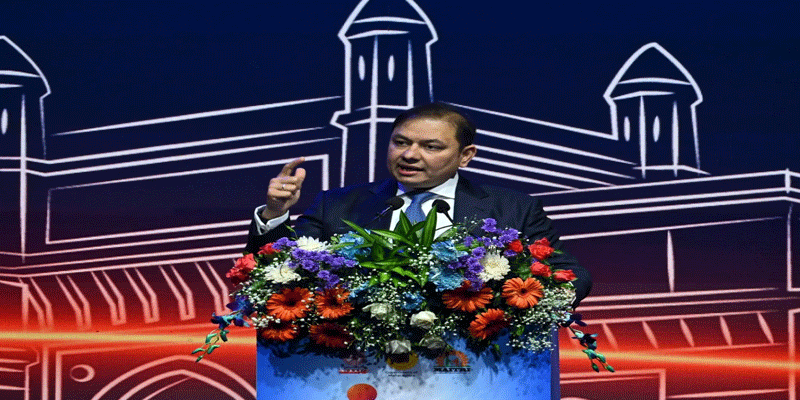
Declaring the launch a “new chapter” in India’s industrial self-reliance, the Prime Minister underlined that the e Vitara would now be exported to over 100 countries, including Europe and Japan. In his address, he reiterated that India’s festive season celebrations should also be about embracing self-reliance, urging citizens to prioritize indigenous products.
“From today, electric vehicles made in India will be exported to 100 countries. Along with this, hybrid battery electrolyte manufacturing is also starting today,” Modi said. He stressed that festivals like Navratri, Diwali, and Dussehra should not only celebrate culture but also symbolize economic independence through the adoption of domestic goods.
Building the Battery Backbone
Central to the announcement was the inauguration of a lithium-ion battery manufacturing facility, established jointly by Suzuki, Toshiba, and Denso under the venture TDS Lithium-Ion Battery Gujarat Private Limited. Modi recalled that this journey began in 2017 with the foundation of the company, highlighting the strategic need for domestic battery production if India was to achieve EV leadership.
The new facility will manufacture over 80% of components and processes required for advanced batteries, substantially reducing imports and enabling large-scale exports. This positions India not only as Suzuki’s primary manufacturing hub for EVs but also as a key node in the global supply chain for clean mobility solutions.
The e Vitara: Designed for the World
Maruti Suzuki’s e Vitara represents the company’s most ambitious push yet into electrification. The electric SUV is 4,275mm long, 1,800mm wide, and 1,640mm high, with a 2,700mm wheelbase—dimensions that place it squarely in the competitive global compact SUV category.
The vehicle features a 3-in-1 electric drive system, integrating motor, inverter, and transmission. Buyers can choose between:
· A 49kWh battery pack paired with a front motor delivering 144hp and 189Nm.
· A 61kWh battery pack paired with a front motor producing 174hp and 189Nm.
For those seeking more power and range, the larger battery supports an all-wheel-drive (AWD) setup, adding a 65hp rear motor for a combined 184hp and 300Nm of torque. This AWD version promises over 500km per charge, positioning it as a strong rival to global EV offerings in the same segment.
Infrastructure and Customer Support
Recognizing that EV adoption hinges on infrastructure, Maruti Suzuki has laid out a comprehensive plan to support e Vitara owners. Each vehicle will be accompanied by a smart home charger with installation support, while public fast-charging networks will be rolled out across India’s top 100 cities within the next two to three years, with charging stations planned at 5–10km intervals.
Additionally, the company will establish 1,500 EV-ready workshops spanning over 1,000 cities, ensuring reliable service and maintenance. This robust after-sales network aims to address consumer apprehensions about EV ownership in India.
A Strategic Response to Global Challenges
The launch comes at a time when global trade uncertainties, including tariff pressures from the United States, are reshaping supply chains. By exporting the e Vitara to multiple continents, India not only secures new markets but also demonstrates its ability to compete in advanced, environmentally sustainable technologies.
This is as much a statement of economic resilience as it is of environmental responsibility. The move aligns with India’s broader climate goals, signaling that the country is ready to lead in green mobility while strengthening its global trade footprint.
Driving Into a New Era
The e Vitara’s debut marks more than the arrival of another SUV—it symbolizes India’s transition from being a car consumer to a car innovator on the world stage. With localized battery production, strong export commitments, and a vision of self-reliance tied to festive spirit, the initiative blends economic ambition with cultural identity.
As India positions itself as a global hub for EV manufacturing, the challenge ahead lies in sustaining affordability, scaling infrastructure, and maintaining quality at par with global benchmarks. If these hurdles are met, the e Vitara may well be remembered as the spark that accelerated India’s electric mobility revolution.
(With agency inputs)