Erdogan’s Kashmir Position Faces Questions of Consistency
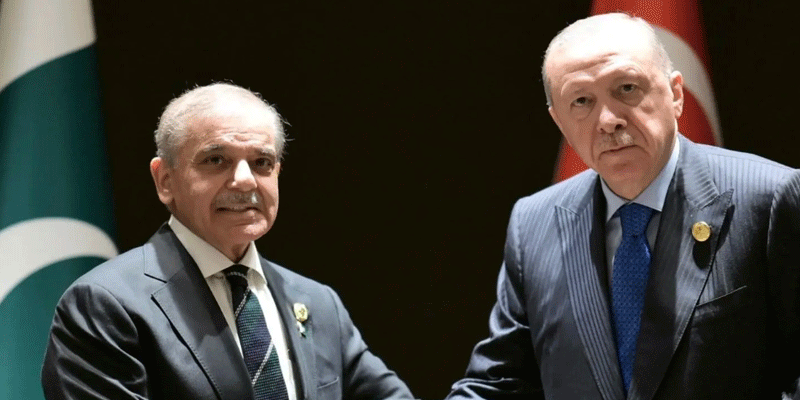
Turkish President Recep Tayyip Erdogan has once again raised Jammu and Kashmir at the UN General Assembly, calling for disputes to be addressed through dialogue, the UN Charter and relevant Security Council resolutions. The statement reflects Ankara’s longstanding position and close ties with Pakistan, but it also invites scrutiny of how Turkey applies principles such as sovereignty, self-determination and human rights in other disputes.
Kashmir and the UN Resolution Question
Erdogan’s reference to relevant UN resolutions is significant because Security Council Resolution 47 of 1948 established a sequence of steps involving the withdrawal of forces and the creation of conditions for a proposed plebiscite. India maintains that subsequent developments fundamentally changed the circumstances and that Jammu and Kashmir is an integral part of India. New Delhi has also consistently rejected third-party mediation.
Erdogan’s repeated UN references therefore remain a point of diplomatic disagreement between Ankara and New Delhi.
Turkey’s Strategic Partnership with Pakistan
Turkey’s Kashmir position also exists within a broader strategic relationship with Pakistan. The relationship includes defence cooperation, military ties and diplomatic coordination. In August 2026, Turkey, Pakistan and Saudi Arabia held the first Strategic Political and Defence Committee meeting under the Makkah Joint Defence Agreement, agreeing to strengthen defence-industry cooperation, joint technology development and collective security mechanisms.
This partnership provides important context for Ankara’s continued engagement with the Kashmir issue, although Turkey presents its position as support for dialogue and peaceful resolution.
The Kurdish Question Creates a Different Standard
The sharper comparison concerns Turkey’s policies toward Kurdish groups. Ankara considers the Kurdistan Workers’ Party, or PKK, a terrorist organisation and cites national-security concerns in its military operations against Kurdish armed groups in Syria and Iraq.
Human Rights Watch has documented allegations of arbitrary detention, enforced disappearances, torture, sexual violence and property seizures in Turkish-controlled areas of northern Syria, including abuses attributed to Turkish-backed Syrian factions. Turkey maintains that its military actions are necessary for national security.
The situations are not identical: Kashmir is an India-Pakistan territorial dispute, while Turkey’s Kurdish conflict involves an armed insurgency and cross-border security operations. Nevertheless, the comparison raises questions about how Ankara balances self-determination claims against sovereignty and security elsewhere.
Armenians, Cyprus and Uyghur Concerns
Turkey’s position on the historical treatment of Armenians remains another contentious issue, while Cyprus presents a direct dispute over sovereignty and recognition. Turkey recognises the Turkish Republic of Northern Cyprus, unlike the overwhelming international position.
The Uyghur issue adds another dimension. Human Rights Watch has reported restrictions on some Uyghurs’ residency and cases involving detention and deportation concerns, particularly amid closer Turkey-China relations.
Principles Must Survive Strategic Interests
Erdogan’s emphasis on dialogue and international law is a legitimate diplomatic position. The broader question is whether those principles are applied consistently across different conflicts.
For India, the response is likely to remain focused on rejecting externalisation of Kashmir while highlighting what it sees as inconsistencies in Ankara’s approach. Ultimately, Turkey’s credibility on Kashmir will depend not only on the principles it invokes at the UN, but also on how consistently it applies comparable standards when sovereignty, security and minority rights collide.
(With agency inputs)