Bengal Heads to Two-Phase Polls; Kerala and Assam Vote on April 9
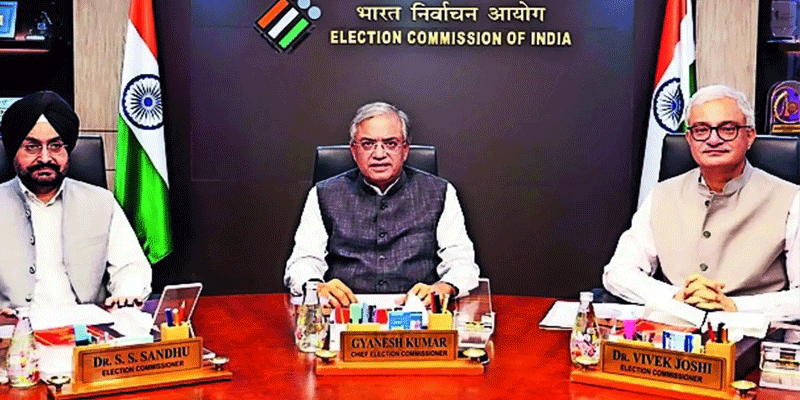
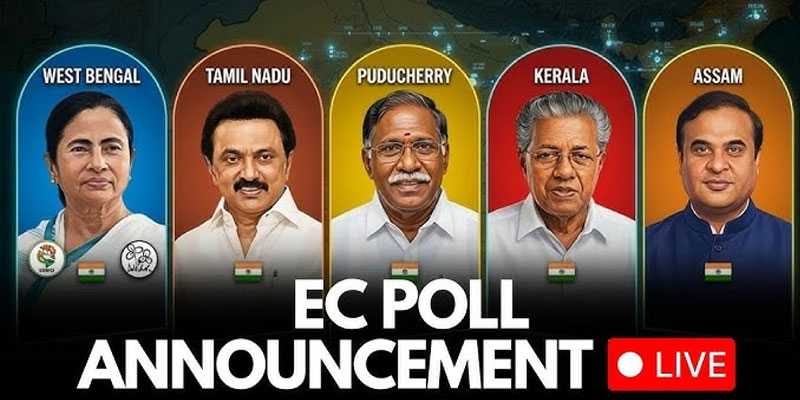
India’s next major electoral test begins as the Election Commission of India announces the schedule for the 2026 assembly elections across West Bengal, Kerala, Assam, Puducherry and Tamil Nadu. The Model Code of Conduct (MCC) has come into force immediately, restricting new policy announcements and tightening oversight on the use of official machinery.
The spotlight initially falls on West Bengal, where polling for the 294-seat assembly will take place in two phases on April 23 and April 29—the fewest phases since 2001. The streamlined schedule is intended to simplify logistics and reduce the risk of electoral violence in politically sensitive districts.
Meanwhile, voters in Kerala, Assam and the Union Territory of Puducherry will cast their ballots in a single phase on April 9. Tamil Nadu will vote later on April 23. Counting for all states is scheduled for May 4. Together, these elections involve around 17.4 crore voters across 824 assembly seats, making them one of the largest multi-state electoral exercises of the year.
Kerala: Can the Left Break the Two-Term Barrier?
The electoral contest in Kerala is particularly significant for the ruling Left Democratic Front (LDF), led by Chief Minister Pinarayi Vijayan. In power since 2016, the LDF is seeking an unprecedented third consecutive term in a state historically known for alternating governments between the Left and the United Democratic Front (UDF).
The UDF, spearheaded by the Indian National Congress, aims to consolidate anti-incumbency sentiment by highlighting fiscal concerns and governance questions. At the same time, the Bharatiya Janata Party (BJP) and its allies under the National Democratic Alliance (NDA) are attempting to expand their footprint in a state where they have historically struggled to convert vote share into seats.
Thus, Kerala’s contest is not merely about government retention but about whether the state’s entrenched political cycle can be broken.
West Bengal: TMC Faces BJP’s Persistent Challenge
In West Bengal, the electoral battle again centres on Chief Minister Mamata Banerjee and her party, the All India Trinamool Congress (TMC), which has dominated the state’s politics since 2011. Banerjee enters the election with a strong organisational network and a governance narrative built around welfare schemes and regional identity politics.
Yet the challenge from the Bharatiya Janata Party remains formidable. After emerging as the principal opposition in 2021, the BJP is seeking to expand its base further by combining national-level messaging with local grievances. Issues such as the Sandeshkhali controversy, law-and-order debates and corruption allegations have been aggressively pushed in the campaign narrative.
At the same time, the state’s traditional opposition forces—including the Communist Party of India (Marxist) and the Indian National Congress—are attempting to regain relevance by consolidating anti-TMC votes in select constituencies. However, the electoral battlefield largely remains a bipolar contest between the TMC’s regional dominance and the BJP’s expansionist strategy.
A Regional Pulse with National Implications
The 2026 assembly elections across eastern and southern India will serve as a critical barometer of political momentum. In Kerala, the key question is whether the Left can rewrite the state’s pattern of alternating power. In West Bengal, the contest tests whether Mamata Banerjee’s regional stronghold can withstand the BJP’s persistent push.
Beyond individual states, these elections reflect broader dynamics—economic anxieties, welfare politics, identity narratives and evolving alliances. Ultimately, voter turnout, ground-level organisation and shifting political sentiments will determine whether incumbents retain their mandates or whether the electorate signals a desire for change.
(With agency inputs)