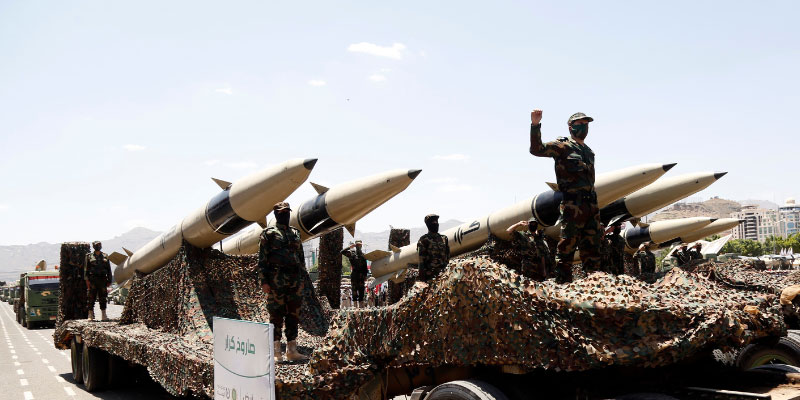
Yemen’s Iran-backed Houthi movement is reportedly attempting to assemble an advanced medium-range ballistic missile using components originating in China, according to a new report by Conflict Armament Research (CAR). If successfully developed, the missile, believed to be based on Iran’s Kheibar Shekan design, could achieve a range of approximately 1,900–2,000 kilometres, potentially placing Israel and large parts of Saudi Arabia within striking distance. The reported development raises fresh concerns about weapons proliferation and security across the Middle East.
From Iranian Weapons to Local Missile Assembly
The Houthis have repeatedly used Iranian-supplied drones, cruise missiles and ballistic missiles against commercial shipping, Israel and regional targets. Their reported effort to assemble a longer-range, precision-guided missile locally could represent an important evolution in their military capabilities.
CAR, a British organisation specialising in tracing weapons and ammunition, based its assessment on information provided by Yemeni authorities in July following the interception of two shipments during 2025. The consignments reportedly originated in China and were destined for Hodeidah, a port controlled by the Houthis.
The findings suggest a possible shift from relying primarily on finished Iranian weapons towards acquiring specialised components through international supply chains.
Seized Components Point to Missile Development
· Propulsion equipment: Rocket-motor aft closures, nozzle attachments and igniters.
· Flight-control structures: Stabilising fin cores designed to help maintain missile stability.
· Specialised materials: Phenolic resin used in ablative heat shields that protect missiles from extreme temperatures during atmospheric flight.
· Custom metal parts: Components intended for missile motors and airframes.
Experts cited by CAR believe the combination of materials points towards an attempt to assemble a Kheibar Shekan-series missile rather than simply importing generic industrial equipment. Former UN Yemen sanctions-panel expert Henry Thompson reportedly said evidence indicated that the Houthis had been importing Chinese components for solid-fuel ballistic missiles for at least two years.
However, the report does not establish that an operational missile of this type has already been produced.
A Wider Threat to Middle Eastern Security
A locally assembled missile with a range approaching 2,000 kilometres could substantially expand the Houthis’ potential reach. It could threaten additional military infrastructure, intensify pressure on Saudi Arabia and Israel, and complicate security calculations around Red Sea shipping routes.
Solid-fuel propulsion can also offer operational advantages, including faster launch preparation and easier storage compared with certain liquid-fuel systems. Improved precision, if achieved, would further increase the potential military significance of the programme.
China’s Position and Unanswered Questions
China maintains that it does not supply arms to the Houthis and says it complies with the United Nations arms embargo. The reported findings do not establish direct involvement by the Chinese government. Investigators must still determine whether the components were knowingly exported for weapons production, diverted through intermediaries or mislabelled as civilian goods.
Supply-Chain Controls Become the Critical Frontline
The reported programme highlights how commercially available and dual-use industrial components can help armed groups develop increasingly sophisticated weapons. Preventing proliferation will require stronger cargo inspections, intelligence-sharing, export controls and monitoring of shipments entering Houthi-controlled ports.
The central concern is not that the Houthis have already fielded this missile, but that the components suggest a serious effort to acquire the capability. For regional governments and international partners, early identification of procurement networks may prove more effective than responding after a longer-range missile becomes operational.
(With agency inputs)