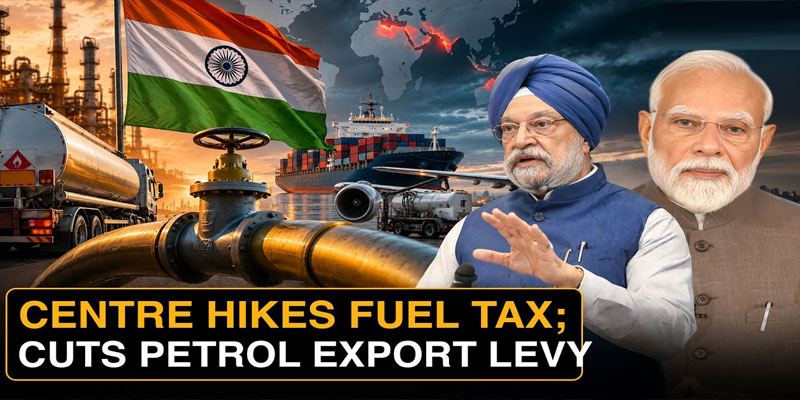
India has revised export levies on petroleum products, increasing the windfall tax on petrol exports from ₹0.50 to ₹2.50 per litre while cutting the duty on diesel exports from ₹16 to ₹8.50 per litre, effective 16 October 2026. The latest revision reflects the government's attempt to balance domestic fuel security, refiners' export economics and volatile international energy prices. The levy on aviation turbine fuel (ATF) remains unchanged at ₹10.50 per litre.
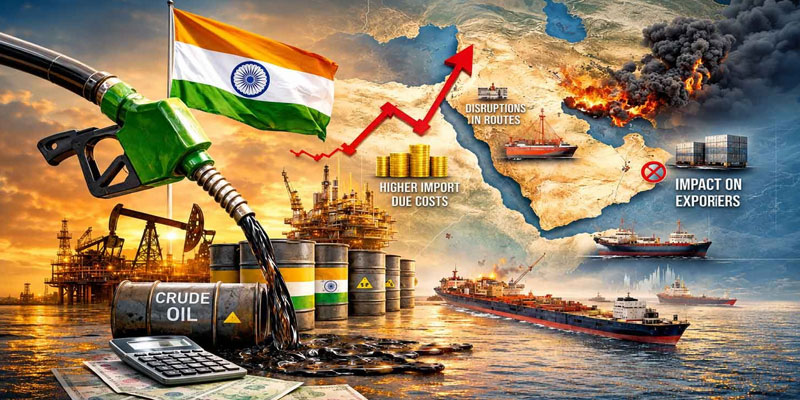
The policy has its roots in India's earlier windfall-tax regime, introduced in July 2022 when elevated global energy prices created opportunities for refiners to earn exceptional returns from overseas sales. Those taxes were withdrawn in 2024 but reintroduced in March 2026 following a surge in crude oil prices amid the US-Israeli war on Iran and wider instability in West Asia. The government introduced export levies to discourage excessive overseas shipments and protect domestic availability. Rates are reviewed every fortnight in response to international crude and petroleum-product prices.
Importantly, the revision concerns exports, not domestic fuel taxation. The Finance Ministry has confirmed that existing excise duty rates on petrol and diesel cleared for domestic consumption remain unchanged. Consequently, the announcement does not, by itself, mean that petrol or diesel prices at Indian fuel stations will immediately rise or fall.
Economic implications and sectoral reactions
The contrasting tax changes suggest a calibrated rather than uniform approach to fuel exports. Raising petrol's levy fivefold increases the cost of overseas sales and may help retain more petrol within India when domestic supply is a concern. Conversely, halving the diesel duty eases the burden on refiners and could improve export competitiveness, particularly as global markets face supply disruptions. India is a major petroleum-product exporter, with substantial refining capacity and established markets across Asia.
· Refiners and exporters: The diesel-duty reduction offers potential relief to companies exporting diesel, including private refiners such as Reliance Industries and public-sector oil companies. Lower export levies may improve net realisations and encourage shipments where international prices remain attractive. However, the higher petrol duty reduces exporters' margins on that product. Actual benefits will depend on crude procurement costs, refining margins and overseas demand.
· Consumers and transport sectors: Motorists, logistics operators and businesses reliant on diesel have no direct tax change to absorb because domestic excise rates remain unchanged. Nevertheless, sustained international oil-price volatility can affect fuel-retailer margins, transport costs and inflation. Any eventual impact on pump prices would depend on broader pricing decisions and market conditions, not simply this export-duty revision.
· Government and energy-security priorities: The government retains flexibility to discourage exports when domestic availability is threatened while easing restrictions when supply conditions permit. The policy also has a fiscal dimension, since higher export levies can capture some gains from favourable international price differentials. However, no specific revenue estimate or official explanation for the petrol-diesel divergence was reported in the latest coverage.
Balancing Energy Security and Export Competitiveness
India's latest revision illustrates the difficult balance between protecting domestic energy security and preserving the competitiveness of its refining industry. The higher petrol export tax reinforces the government's supply-management priorities, while the reduced diesel duty offers exporters partial relief amid global market uncertainty. For now, the immediate significance lies in export economics rather than domestic pump prices. The next fortnightly review will be important in determining whether the government continues easing diesel restrictions or tightens levies again in response to geopolitical developments and international fuel prices.
(With agency inputs)