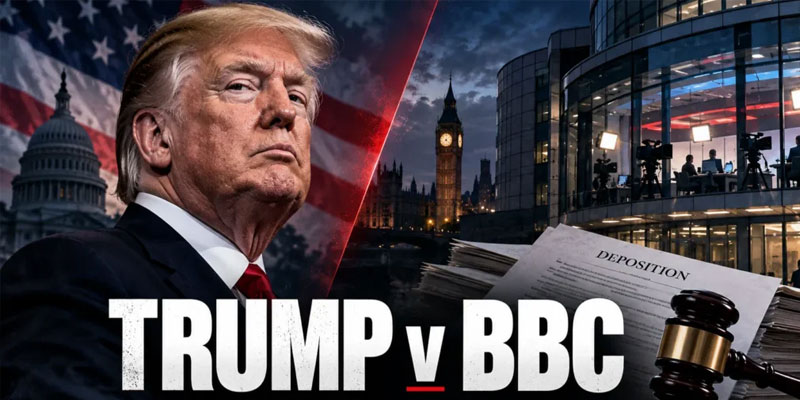
President Donald Trump has been ordered to answer questions under oath by December 11 in his $10 billion defamation lawsuit against the BBC, intensifying a legal battle over the broadcaster’s editing of his January 6, 2021, speech. The order, issued by US Magistrate Judge Enjoliqué Lett during a hearing in Miami, follows the BBC’s complaint that Trump had delayed the proceedings.
The judge warned that failure to comply could invite sanctions, potentially including dismissal of Trump’s lawsuit, unless the court extends the discovery deadline.
What Is Behind the Trump-BBC Legal Battle?
Trump filed the lawsuit in December, alleging that a BBC documentary, Trump: A Second Chance?, deceptively edited portions of his speech before the US Capitol attack on January 6, 2021. He claims the programme presented separate portions of his remarks in a way that misleadingly suggested he directed supporters to storm the Capitol.
Trump is seeking at least $10 billion in damages, arguing that the broadcast harmed his reputation and caused substantial injury. The BBC disputes the defamation allegations and maintains that the editing does not establish legal liability.
The case is part of a broader pattern of Trump pursuing legal action against media organisations over coverage he considers damaging.
Why the Deposition Deadline Matters
The court’s order followed the cancellation of a deposition scheduled for October 16, prompting the BBC to seek judicial intervention. Judge Lett directed Trump to appear by December 11, although the deadline could change if the presiding judge extends discovery, which is currently scheduled to conclude on December 18.
During a deposition, BBC lawyers could question Trump under oath about several key issues:
· The original January 6 speech and the alleged misleading editing.
· The reputational and financial harm he claims to have suffered.
· The evidence supporting his $10 billion damages demand.
Trump’s lawyers have denied that he is avoiding testimony, arguing that presidential responsibilities and security arrangements must be accommodated. They previously proposed dates in January, subject to the condition that the deposition not be video-recorded.
Financial Records Become Another Battleground
The judge also partly granted the BBC’s request for financial information relating to Mar-a-Lago, Trump’s private Florida club.
The broadcaster may obtain the total number of membership applications received between January 6, 2020, and January 6, 2026, together with figures relating to memberships and initiation fees for new applicants.
The BBC argues that the information could help establish whether the documentary caused measurable damage to Trump’s business interests. Trump’s lawyers have challenged the requests as overly broad and irrelevant.
The dispute highlights a central issue in defamation litigation: establishing not simply that a publication was allegedly harmful, but that legally recognisable damage occurred and can be supported by evidence.
Legal Stakes for Trump and the BBC
The December deadline places pressure on both parties as they prepare for the next stages of litigation. If Trump fails to comply without an authorised extension, dismissal of his own lawsuit could become a possible sanction, although such an outcome is not automatic.
For the BBC, access to testimony and financial records could help challenge the basis of Trump’s damages claim. For Trump, the deposition presents an opportunity to defend his allegations, but also exposes his account of the alleged harm to direct questioning.
Courtroom Accountability Could Decide the Case’s Future
The dispute goes beyond the confrontation between a US president and an international broadcaster. It raises important questions about editorial responsibility, reputational harm and the evidence required to sustain a substantial defamation claim.
Ultimately, the case will turn on the evidence, applicable defamation law and the court’s assessment of the competing arguments. The deposition deadline marks a significant procedural development, but the lawsuit’s outcome will depend on whether Trump can substantiate his allegations and whether the BBC’s defence withstands judicial scrutiny.
(With agency inputs)