A Charged Political Climate in Bihar
As Bihar gears up for its crucial Assembly elections, the state’s political landscape is once again abuzz with activity, strategy, and speculation. Known for its intricate caste arithmetic and shifting alliances, Bihar stands on the brink of another fiercely contested election. The National Democratic Alliance (NDA), led by the Bharatiya Janata Party (BJP) and Janata Dal (United), has officially finalized its seat-sharing formula — a move that could shape the state’s political destiny for the next five years.
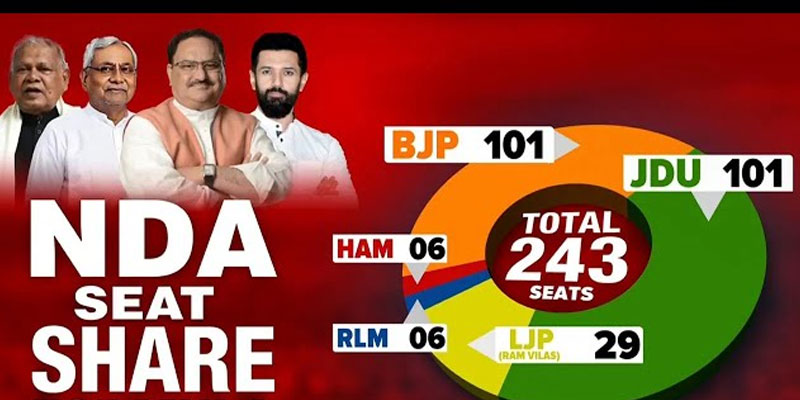
After weeks of negotiation, the NDA announced that both BJP and JD(U) will contest 101 seats each out of the 243-member Assembly. The remaining seats have been distributed among smaller allies — Lok Janshakti Party (Ram Vilas) with 29 seats, and Rashtriya Lok Morcha (RLM) as well as Hindustani Awam Morcha (HAM) with six seats each. The decision marks a strategic shift in the alliance’s internal power balance.
A New Equation Within the NDA
The announcement, made on October 12, reflects a notable change — this is the first time JD(U) will contest an equal number of seats as the BJP, breaking its past dominance in the alliance. Union Minister Dharmendra Pradhan, the NDA’s Bihar election in-charge, described the talks as “cordial and consensus-driven,” claiming that “Bihar is ready for another NDA government.”
The distribution settles weeks of tension among alliance partners. Both HAM, led by former Chief Minister Jitan Ram Manjhi, and RLM, headed by Upendra Kushwaha, had earlier threatened to contest independently if not given a “respectable” number of seats. The final allocation of six seats each appears to have pacified them for now.
Chirag Paswan, leader of the LJP (Ram Vilas), emerged as the biggest gainer, securing 29 constituencies. His party’s strong performance in the 2024 Lok Sabha elections, where it won all five contested seats, seems to have bolstered his bargaining power within the NDA.
Opposition’s Unity Tested
On the other side of the political battlefield, the INDIA bloc — comprising the Rashtriya Janata Dal (RJD), Congress, and Left parties — insists that its seat-sharing negotiations are on track, despite growing whispers of discontent. RJD MLA Bhai Virendra dismissed rumors of discord, promising that “everything will be revealed” in a joint press conference.
However, a viral image of Tejashwi Yadav and Congress leader Akhilesh Prasad Singh chatting on a flight from Patna to Delhi fueled speculation of last-minute deal-making. Still, RJD sources maintain that the alliance remains intact in its bid to unseat Chief Minister Nitish Kumar, who continues to be a central, if polarizing, figure in Bihar politics.
Mood on the Ground: Voters Weigh Familiar Choices
In the dusty towns and far-flung villages of Bihar, the political mood appears cautious yet curious. Many voters express fatigue over frequent power shifts between familiar faces — Nitish Kumar’s JD(U), the BJP, and the RJD. While some hail the NDA’s governance record on infrastructure and welfare, others lament rising unemployment and stagnant rural development.
Caste loyalties, traditionally a defining factor in Bihar elections, continue to play a subtle yet decisive role. Analysts suggest that the equal seat-sharing between BJP and JD(U) may boost perceptions of unity within the NDA, though much will depend on grassroots mobilization and voter turnout in the two-phase polling on November 6 and 11.
A Battle of Balance and Belief
The NDA’s carefully balanced seat-sharing formula underscores its determination to present a united front, while also revealing the evolving dynamics between the BJP and JD(U). For Nitish Kumar, it’s a test of endurance and legacy; for the BJP, a chance to expand its influence in Bihar’s complex political ecosystem.
As campaign caravans prepare to roll out and promises fill the air, Bihar’s voters now hold the ultimate power to decide whether to endorse continuity or opt for change. The coming weeks promise a spirited contest — one where strategy, sentiment, and symbolism will determine who captures the political heart of Bihar.
(With agency inputs)