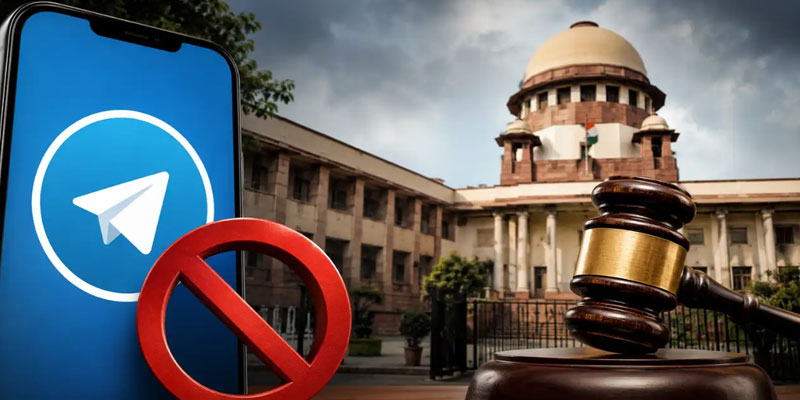
The temporary restrictions imposed on Telegram ahead of the NEET-UG 2026 re-test remained in force as the Delhi High Court heard the platform’s challenge to the Centre’s decision. During proceedings on June 18, Justice Tejas Karia, sitting on a vacation bench, reserved judgment on Telegram’s plea while allowing the event-linked restrictions to continue until June 22, covering the re-examination scheduled for June 21. The court observed that the matter involved competing concerns of public interest, examination integrity and digital rights, prompting a closer scrutiny of the proportionality of the government’s action.
Exam Integrity and the Telegram Controversy
The dispute emerged in the aftermath of allegations surrounding the NEET-UG 2026 paper leak, an issue that affected millions of aspirants and triggered concerns over the credibility of one of the country’s most important entrance examinations. Acting on recommendations from the National Testing Agency (NTA), the Centre invoked Section 69A of the Information Technology Act, 2000, to temporarily restrict access to Telegram.
According to the government, the measure was aimed at preventing the dissemination of leaked examination material and curbing organised networks allegedly involved in circulating question papers and facilitating illegal transactions linked to examination fraud. The restrictions were designed as a short-term, event-specific intervention tied directly to the re-test.
Court Examines the Question of Proportionality
A central theme during the hearing was whether restricting access to a platform used by an estimated 150 million Indians could be justified to protect the interests of NEET candidates.
Justice Tejas Karia repeatedly questioned the proportionality of the measure, asking whether the rights of a vast number of users could be curtailed because a specific group was appearing for an examination. The court sought to determine whether the government’s objective could be achieved through less restrictive alternatives and whether Telegram’s own technological architecture enabled effective monitoring and intervention against misuse.
The bench also questioned Telegram about its ability to address the problem in real time. When the company argued that the alleged leaked paper circulating online was misinformation, the court responded that the larger issue was the existence of examination-related material being shared on the platform.
Centre’s Case: Telegram as a Security Risk
In a strongly worded affidavit, the Centre described Telegram as the “new dark web,” alleging that criminal actors increasingly use the platform to connect users with hidden online networks and illicit forums. The government claimed that Telegram’s features, including anonymity tools, bot infrastructure, editable message timestamps and the use of virtual phone numbers, make enforcement and traceability difficult.
Government lawyers further alleged that a channel linked to the so-called “NEET mafia” had over 18,000 subscribers and was involved in circulating paper leak content, collecting payments and facilitating advance bookings. Solicitor General Tushar Mehta argued that a platform unable to adequately prevent such misuse could not rely solely on arguments of proportionality.
Telegram’s Defence and the Broader Implications
Telegram countered that the ban was “grossly disproportionate,” affecting millions of ordinary users, including students, businesses and educational communities. The platform maintained that restricting access would not eliminate leaks, which could simply migrate to other services.
Balancing Rights and Public Interest
The case underscores a growing legal challenge in the digital era: balancing fundamental rights with the need to protect public institutions and national interests. While the restrictions continue as a temporary measure linked to the NEET re-test, the Delhi High Court’s forthcoming verdict is expected to clarify the limits of state intervention on digital platforms and establish important principles on proportionality, accountability and platform responsibility in times of public exigency.
(With agency inputs)