Nepal PM Revives Debate Over Contested Territories
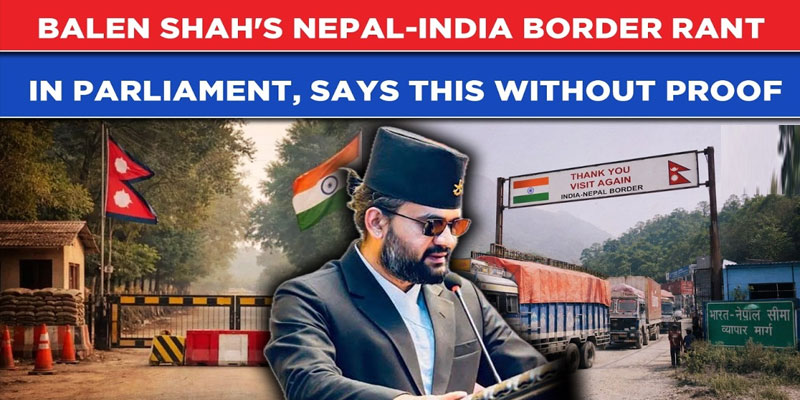
Nepal Prime Minister Balendra Shah has reignited discussion over the decades-old border dispute with India by stating that both countries have “encroached” upon each other’s territories. Addressing Nepal’s Parliament, Shah adopted a notably balanced position, acknowledging competing territorial claims rather than placing sole responsibility on either side. He said Kathmandu and New Delhi had agreed to pursue a diplomatic resolution with the help of historians, surveyors, and technical experts, while also referring to consultations involving China and the United Kingdom.
The remarks have brought renewed attention to one of the most sensitive issues in India-Nepal relations: the ownership of the Kalapani, Lipulekh, and Limpiyadhura regions in the western Himalayas.
The origins of the disagreement date back more than two centuries to the 1816 Treaty of Sugauli, signed between Nepal and British India after the Anglo-Nepalese War. The treaty defined Nepal’s western boundary as the Kali River. However, it did not conclusively identify the river’s exact source, creating the foundation for future disputes.
Over time, India and Nepal developed different interpretations of where the Kali River begins. This disagreement has evolved into competing territorial claims over a strategically important stretch of Himalayan terrain located near the India-Nepal-China tri-junction.
Although the issue remained relatively subdued for decades, it periodically resurfaced through diplomatic protests, political statements, and cartographic disputes.
Understanding the Kalapani-Lipulekh-Limpiyadhura Dispute
The dispute centres on three interconnected regions: Kalapani, Lipulekh, and Limpiyadhura.
Nepal argues that the Kali River originates at Limpiyadhura, located northwest of Kalapani. Based on this interpretation, Kathmandu claims the entire area extending from Limpiyadhura through Kalapani and Lipulekh as part of Nepalese territory.
India, however, maintains that the river originates from the Pankhagad stream near southern Kalapani. Under this interpretation, the disputed territory falls within India's Uttarakhand state.
The stakes extend beyond geography. Kalapani occupies a strategic position near the tri-junction with China, while Lipulekh Pass serves as an important route for the Kailash-Mansarovar pilgrimage and cross-border connectivity. Limpiyadhura is significant because it is central to determining the river’s source and, by extension, the international boundary.
Key Developments Over the Years
The dispute has witnessed several major milestones. Nepal formally raised concerns through diplomatic channels in the early 1990s. Tensions increased after India and China reopened the Lipulekh Pass route in 1997, prompting stronger protests from Kathmandu.
A major escalation occurred in 2020 when Nepal approved a new political map incorporating Kalapani, Lipulekh, and Limpiyadhura within its borders. India rejected the move, describing it as an artificial expansion of territorial claims.
Most recently, Nepal objected to India's decision to resume the Kailash-Mansarovar pilgrimage through Lipulekh in May 2026, arguing that the route passes through territory claimed by Kathmandu.
A Possible Opening for Dialogue
Despite recurring tensions, Prime Minister Shah's remarks may signal a more pragmatic phase in the dispute. By acknowledging mutual claims and emphasizing expert-led dialogue, Nepal appears to be shifting away from a purely confrontational approach. India has consistently maintained that the issue should be resolved through bilateral negotiations, and both sides have reaffirmed their commitment to diplomatic engagement.
The Kalapani-Lipulekh-Limpiyadhura dispute remains a complex blend of history, geography, and national identity. Yet the latest exchanges suggest that New Delhi and Kathmandu may be seeking common ground rather than deepening divisions. Whether this leads to a lasting resolution remains uncertain, but the renewed emphasis on dialogue offers a rare opportunity to address one of South Asia's longest-running border disagreements through diplomacy rather than confrontation.
(With agency inputs)