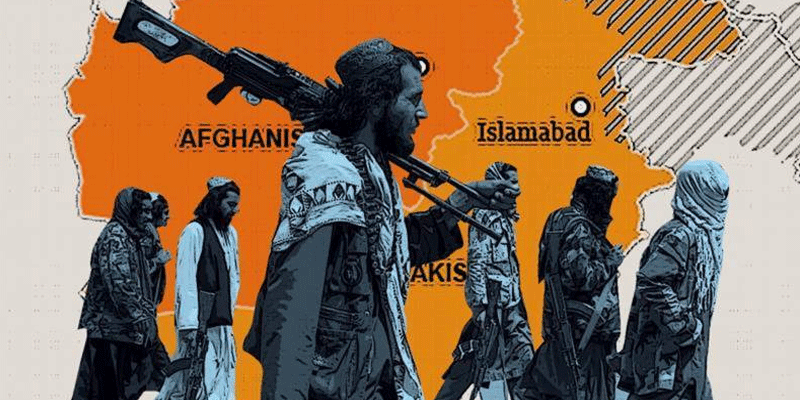
Pakistan has carried out its second round of strikes inside Afghanistan this week, targeting 10 locations that Islamabad says were connected to drone operations against its territory. Reports of an overnight strike in Kandahar, the political and spiritual centre of Afghanistan’s Taliban leadership, add a particularly sensitive dimension to the escalation. Pakistan describes the operation as self-defence, while Kabul regards such attacks as violations of Afghan sovereignty.
A Sharp Escalation Across the Border
Information Minister Attaullah Tarar said Pakistani aircraft and drones struck sites allegedly used to launch and store drones. He described the operation as “deliberate, precise, calibrated and proportionate” and said the targets were restricted to military objectives linked to attacks against Pakistan. Pakistani officials said their air-defence systems had intercepted eight drones that entered Pakistani airspace on September 23.
The latest action follows Pakistani strikes in Kunar and Paktika on September 21. Islamabad said 28 militants were killed, while Afghan authorities reported civilian casualties. UNAMA confirmed the deaths of three civilians—a man, a woman and a girl—and injuries to four others in Kunar.
The TTP Lies at the Heart of the Dispute
At the centre of the confrontation is the Tehreek-e-Taliban Pakistan (TTP), which Islamabad accuses of operating from sanctuaries in Afghanistan and launching attacks inside Pakistan.
Pakistan argues that the Taliban government has failed to take credible action against the group. Kabul rejects the accusation and maintains that Pakistan’s internal security problems cannot justify cross-border military operations.
The dispute has become increasingly difficult to contain because both governments view the issue through fundamentally different security and sovereignty lenses.
From Former Partners to Strategic Rivals
Pakistan and Afghanistan’s Taliban movement once shared close political, religious and strategic ties. Relations deteriorated after the Taliban returned to power in 2021, particularly over:
· TTP activities and alleged militant sanctuaries.
· Pakistan’s fencing of the disputed Durand Line.
· Kabul’s refusal to accept the Durand Line as a permanent international border.
· Repeated cross-border attacks and military operations.
The confrontation escalated dramatically earlier this year, when Pakistan launched strikes against targets in Afghanistan and fighting spread across the border. Although mediation efforts produced temporary ceasefires, the underlying security dispute remains unresolved.
Why Kandahar Matters
The reported strike on Kandahar is especially sensitive because the city is closely associated with Taliban Supreme Leader Hibatullah Akhundzada. Even if the intended target was a military installation rather than a Taliban leader, striking in the Taliban’s political heartland carries significant symbolic weight. AFP reported that residents heard an aircraft followed by a large explosion in the city.
The danger is that retaliation could trigger another cycle of airstrikes, border clashes and militant attacks, while civilian casualties could further inflame Afghan public opinion.
Diplomacy Now Faces Its Hardest Test
China, Qatar, Turkey and Saudi Arabia have all been involved in efforts to reduce tensions, but mediation has struggled to bridge the central disagreement over the TTP and cross-border military action.
A durable settlement will require verifiable measures against militant networks, mechanisms for investigating attacks and civilian casualties, and sustained third-party engagement. Without those safeguards, Pakistan’s military response may deliver immediate tactical objectives but risk transforming a counterterrorism dispute into a prolonged interstate confrontation. The reported strike on Kandahar shows how quickly that boundary is narrowing.
(With agency inputs)