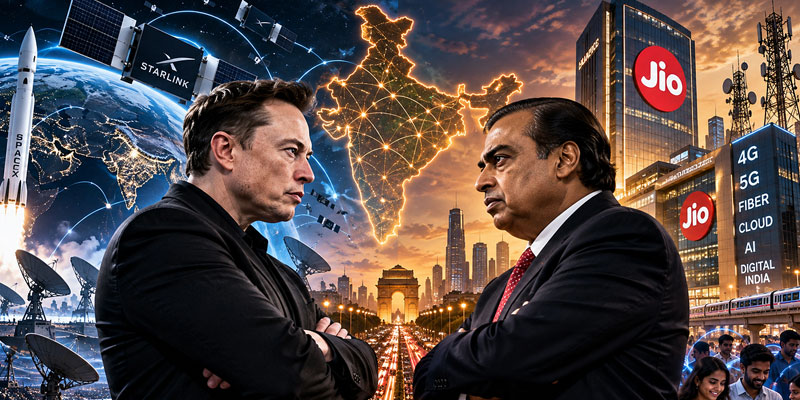
Reliance Breaks Silence on Starlink Dispute
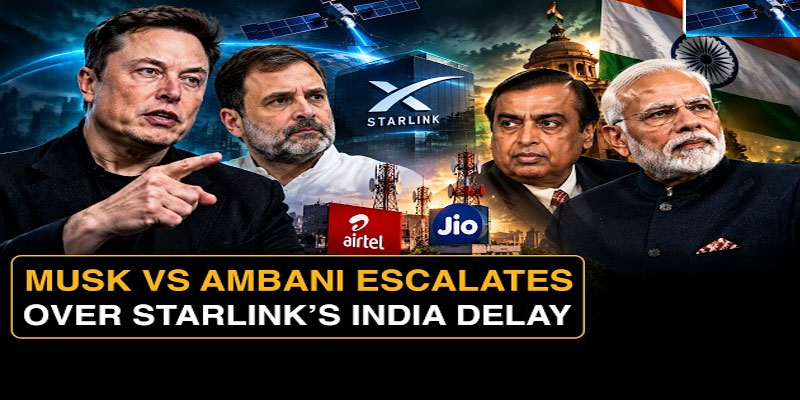
Reliance Industries has pushed back against Elon Musk’s allegations that Mukesh Ambani is obstructing Starlink’s entry into India, asserting that Jio welcomes competition but is itself awaiting government clearances for satellite communication services. The response has intensified a high-profile corporate dispute over access to India’s rapidly expanding telecommunications market, where regulatory approvals will shape competition among domestic and international players.
The exchange comes at a commercially sensitive time for Reliance, with its Jio business preparing for a reported $108 billion initial public offering (IPO), placing additional scrutiny on the company’s competitive position and its approach to emerging rivals.
The Musk-Ambani Satellite Standoff
The dispute escalated after Musk accused unnamed Indian business interests of maintaining a “monopolistic chokehold” on consumers. He subsequently questioned on X whether Ambani was “the real boss of India,” suggesting that powerful domestic players were influencing Starlink’s delayed entry.
Musk has maintained that Starlink has worked towards meeting Indian regulatory requirements for years but has yet to begin commercial operations.
India’s Ministry of Communications rejected the suggestion of discriminatory treatment, describing the country’s satellite-communications regulatory framework as fair and non-discriminatory. According to the government, Starlink, Reliance-controlled Jio Satellite Communications and Bharti-backed Eutelsat OneWeb are at broadly comparable stages, with security assessments underway and spectrum allocation pending.
Reliance’s Response: Competition Under Common Rules
Reliance said it had “never feared competition” and welcomed investment and innovation that improve the lives of Indians, including Starlink’s proposed services. However, it emphasised that every operator must comply with Indian laws and policies, adding that Jio’s satellite services are also awaiting the necessary clearances.
The response shifts attention from allegations of corporate obstruction towards the government’s regulatory process. With Jio’s anticipated IPO adding commercial significance, Reliance has a strong incentive to demonstrate that its market position does not depend on restricting potential competitors.
Starlink Says It Is Ready to Connect India
Starlink maintains that it has spent more than five years working with Indian authorities and industry partners, developing infrastructure and meeting regulatory requirements. It says it has obtained a Department of Telecommunications licence and IN-SPACe authorisation, and has signed distribution agreements with Reliance Jio and Bharti Airtel.
However, these approvals do not automatically authorise commercial operations. Security clearances, spectrum assignment and other regulatory requirements must still be completed.
What Is at Stake for India?
Satellite internet could extend high-speed connectivity to remote villages, mountainous regions and underserved areas where conventional telecom infrastructure is expensive or difficult to deploy.
The outcome will influence competition among Starlink, Jio and Eutelsat OneWeb, while potentially expanding internet access for millions of consumers and businesses.
Regulatory Fairness Will Decide the Satellite Race
The Musk-Ambani dispute has raised questions about market access, corporate influence and India's regulatory credibility. Yet the decisive issue is whether approvals are processed transparently, consistently and within a reasonable timeframe. If all operators face equivalent requirements, the government’s position will gain credibility. If significant differences emerge in the treatment or pace of applications, demands for greater transparency are likely to intensify. Ultimately, India’s interests lie in ensuring fair competition, protecting national security and bringing reliable satellite connectivity to underserved communities without granting any company preferential treatment.
(With agency inputs)