A Renewed Push for Economic Ambition
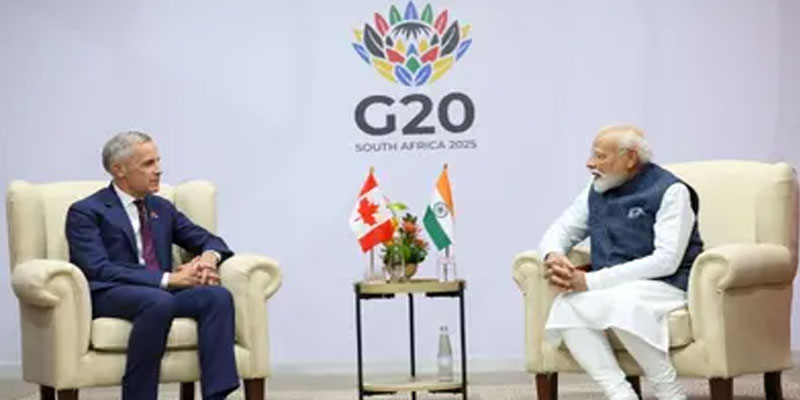
Prime Minister Narendra Modi and Canadian Prime Minister Mark Carney have opened a new chapter in India–Canada relations, unveiling an ambitious plan to raise bilateral trade to USD 50 billion by the early 2030s. This declaration signals a determined shift from years of diplomatic friction toward a future anchored in economic opportunity, strategic cooperation, and mutual trust.
Rebuilding a Fractured but Vital Relationship
India and Canada share deep-rooted democratic values, people-to-people ties, and complementary economic strengths. Yet, over the past few years, their relationship has weathered significant turbulence, slowing progress in areas where both nations stand to benefit. The renewed dialogue between Modi and Carney seeks to reverse that drift—by prioritizing a pragmatic blueprint for trade, investment, technology partnership, and geopolitical alignment. At its core, the reset reflects a shared desire to modernize bilateral engagement while ensuring that political differences do not eclipse long-term cooperation.
The Roadmap to USD 50 Billion: Expanding Trade Frontiers
The restart of high-level talks marks a critical milestone after a two-year diplomatic freeze. With bilateral trade roughly USD 30 billion in 2024, leaders have identified key sectors—technology, agriculture, energy, defence, and space—as prime engines of expansion.
A renewed focus on the Comprehensive Economic Partnership Agreement (CEPA) underscores the strategic intent: simplifying market access, lowering trade barriers, and shaping a more predictable policy environment for businesses. Canadian pension funds, long time investors in India’s infrastructure and green energy sectors, are signaling stronger interest in scaling commitments—reflecting India’s status as one of the world’s most attractive emerging markets.
The meeting, attended by top diplomats including External Affairs Minister S. Jaishankar and Canadian Foreign Minister Anita Anand, also highlighted new initiatives in defence manufacturing, sustainable energy, and next-generation technologies.
Defence and Space: Strengthening Strategic Alignment
Beyond commercial ties, the countries are exploring deeper collaboration in defence procurement, civil nuclear energy, and space research—aligned with broader global shifts in security and technology.
The trilateral Australia–Canada–India Technology and Innovation (ACITI) platform is expected to accelerate progress in nuclear energy innovation, AI ecosystems, and resilient supply chains. Carney’s participation in India’s AI summit in 2026 is set to reinforce technology as a focal point of bilateral cooperation, potentially giving India–Canada ties a forward-looking, innovation-led character.
From Tensions to Trust: Navigating a Difficult Past
This renewed engagement follows a period of significant strain, most sharply felt during the 2023–2024 diplomatic crisis involving the killing of Hardeep Singh Nijjar. The episode triggered expulsions, suspended consular operations, and public friction over Sikh separatism and foreign interference.
By 2025, however, both nations recognized the necessity of recalibrating ties. High Commissioners were reinstated, security talks resumed, and a structured channel for addressing contentious issues—terrorism, sovereignty concerns, and diaspora sensitivities—was reopened.
The current roadmap is thus not merely economic: it is a political acknowledgment that sustainable partnership requires dialogue, respect, and careful management of differences.
A Hopeful Path Toward Stronger Ties
India and Canada now stand at a moment of cautious optimism. Their shared ambitions—in trade, technology, security, and innovation—offer a solid foundation for rebuilding trust and expanding cooperation.
If sustained with openness and maturity, this renewed engagement could transform bilateral ties, allowing both nations to move beyond past disputes and unlock a productive, future-facing partnership. The hope is clear: that this reset will pave the way for the strongest era yet in India–Canada relations.
(With agency inputs)