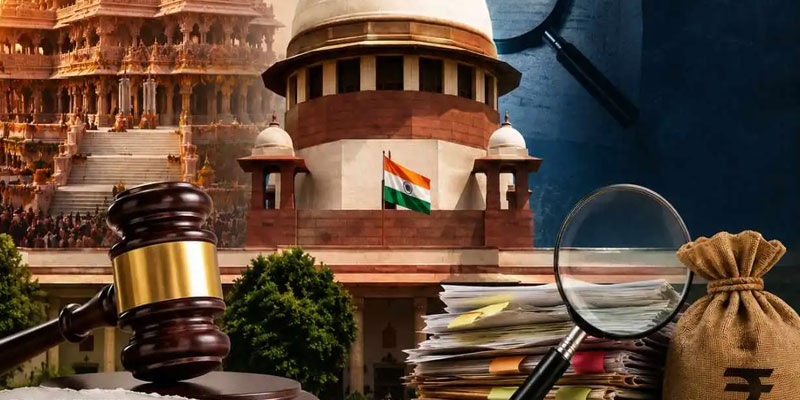
SC: Ram Temple Donation Theft Probe Must Stay Apolitical
The Supreme Court has underlined that the alleged Ram Temple donation theft case should be treated purely as a criminal investigation and not as a political issue. While hearing petitions relating to the alleged embezzlement of donations made to the Shri Ram Janmabhoomi Teerth Kshetra Trust, the Court suggested that the Uttar Pradesh government reconstitute the Special Investigation Team (SIT) with experienced officers capable of conducting a fair, impartial and transparent investigation. At the same time, the bench cautioned all parties against politicising the matter, observing that judicial proceedings should focus on facts and evidence rather than ideological or partisan narratives.
Allegations of Misappropriation of Temple Donations
The controversy stems from allegations that donations and offerings collected for the Ram Temple in Ayodhya were allegedly misappropriated or diverted. The claims prompted the filing of Public Interest Litigations (PILs) seeking an independent and court-monitored investigation into the Trust's financial dealings.
Following the allegations, the Uttar Pradesh government constituted a Special Investigation Team to probe the matter, while local police registered an FIR in a related donation theft case that led to the arrest of multiple accused. Petitioners also sought a Central Bureau of Investigation (CBI) inquiry and a forensic audit of the Trust's accounts, arguing that the issue involved significant public faith and financial transparency.
Earlier this month, the Supreme Court sought a detailed status report from the SIT, asking the state government to explain the team's composition and the progress made in the investigation before deciding whether further judicial intervention was necessary.
Court Calls for a Stronger and More Credible Investigation
After examining the SIT's status report submitted in a sealed cover, the Supreme Court indicated that the present investigation required greater institutional credibility. The bench suggested that the Uttar Pradesh government consider reconstituting the SIT under the leadership of a senior IPS officer with proven experience in investigating complex financial crimes, corruption cases or economic offences.
According to the Court, a professionally equipped investigation team would inspire greater public confidence and help take the probe to its logical conclusion. However, the bench stopped short of issuing immediate directions, instead listing the matter for further hearing on July 27 while asking the state government to seek instructions on strengthening the investigation.
Judiciary Draws a Clear Line Against Politicisation
One of the Court's strongest observations was its warning against attempts to convert the case into a political contest. The bench emphasised that the issue before it was a "simple case of crime" involving allegations of financial misappropriation and should be examined strictly through the lens of criminal law.
The judges reminded all stakeholders that the investigation must determine whether donations were actually diverted, identify those responsible, and establish accountability through legally admissible evidence. Broader political debates surrounding the Ram Temple or Ayodhya, the Court observed, should not influence the judicial process.
What Lies Ahead for the Investigation
The sealed-cover SIT report will play a crucial role in determining the Court's next course of action. Depending on the government's response and the credibility of the reconstituted investigation, the Court may opt for closer judicial monitoring or keep open the possibility of transferring the probe to a central agency such as the CBI.
For the Uttar Pradesh government, the case presents an opportunity to demonstrate that allegations involving one of India's most prominent religious institutions will be investigated with complete transparency and professionalism.
Justice Must Prevail Beyond Faith and Politics
The Supreme Court's observations reaffirm a fundamental constitutional principle: allegations of financial wrongdoing must be investigated impartially, irrespective of the institution or emotions involved. By insisting on a stronger SIT while cautioning against political exploitation, the Court has sought to preserve both public confidence and judicial neutrality. The credibility of the investigation—and the willingness of the state to ensure institutional accountability—will ultimately determine whether the controversy is resolved through the rule of law rather than political rhetoric.
(With agency inputs)