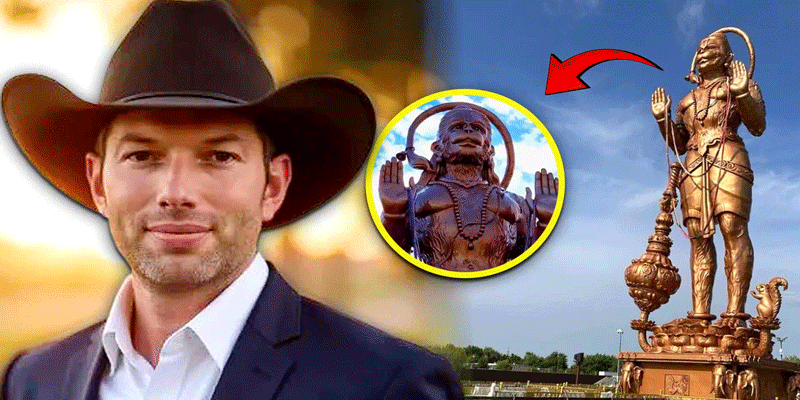
A social media post by conservative YouTuber Jesse Hughes has turned a 90-foot statue of Lord Hanuman in Texas into a political and religious flashpoint. Hughes posted a photograph of the monument on X with the message, “Btw, when we win, we are tearing this down,” without explaining what “win” referred to. The post triggered criticism from Hindu organisations, Indian-American voices and US military veterans.
A Landmark at The Heart of The Dispute
Known as the Statue of Union, the 90-foot Panchaloha statue stands at the Sri Ashtalakshmi Temple in the Houston-area community of Sugar Land. It was formally inaugurated in August 2024 and was created as a representation of Lord Hanuman, associated in Hindu tradition with strength, devotion and selfless service. The temple describes it as a spiritual landmark intended to promote unity and devotion.
The monument had already attracted criticism from some Christian groups after its unveiling. In August 2024, a local church group demonstrated near the statue, prompting the temple to consider additional security measures.
Viral Post Triggers Sharp Response
Hughes’ latest post brought the controversy back into the national spotlight. Although he did not identify a specific political victory or explain how the statue could legally be removed from private temple property, the wording was interpreted by critics as a call for its destruction.
Ruchir Bakshi, a Hindu American and US Army veteran, responded forcefully, arguing that targeting another community's place of worship conflicts with the principles for which he served. His response was subsequently amplified by Hindu advocacy groups and other veterans.
The dispute has consequently moved beyond the statue itself, touching on broader questions of religious liberty, political rhetoric and the place of Hindu Americans within an increasingly diverse US society.
Why The Texas Context Matters
Texas has a large and increasingly visible Indian-American population, particularly around major metropolitan areas such as Houston and Dallas. The controversy therefore arrives amid wider political debates over immigration, religion, cultural identity and the role of minority communities.
Importantly, the Hanuman monument is located on private temple property, rather than being a government-owned religious installation. That distinction is central to understanding the dispute and the legal context surrounding calls for its removal.
From Social Media Post to Political Symbol
The episode also demonstrates how religious symbols can rapidly become political symbols in the social-media era. For Hindu organisations and supporters, the controversy raises concerns about whether Hindu places of worship can be openly targeted in political rhetoric. For Hughes and those responding to the broader cultural debate, the statue has become part of wider arguments about religion and American identity.
Beyond One Statue, A Larger American Question
No official government action to remove the monument has been reported. The immediate controversy remains centred on Hughes’ statement and the responses it generated. Yet its wider significance lies in the questions it has exposed: how should religious freedom, political expression and America’s growing religious diversity coexist? The answer will ultimately depend not on social-media rhetoric, but on constitutional protections, property rights and the broader civic principle that different faith communities can maintain places of worship without facing discrimination.
(With agency inputs)