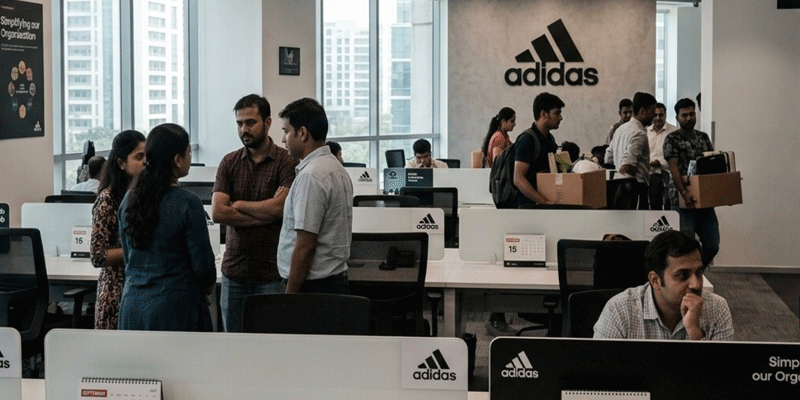
Adidas India’s technology organisation is undergoing a significant restructuring, with employees at its Gurugram technology hub informed about role reductions during a September 15 town hall. The German sportswear giant says the changes affect less than 20% of its India Technology organisation, while reports citing people familiar with the matter estimate that 350 or more employees at the Gurugram hub could be affected.
A Restructuring, not an India Exit
Adidas has described the move as an effort to simplify its organisation, strengthen critical capabilities and align its technology model with changing business requirements. The affected roles reportedly include software engineers, data scientists and data engineers.
The distinction is important. Adidas has not announced a withdrawal from India. Its Gurugram facility is one of its Global Engineering Tech Hubs, while the company also operates a Global Business Services centre in Chennai. Adidas has stressed that India remains strategically important to its technology and digital-transformation plans.
How Many Jobs Have Been Affected?
The exact number remains unclear because Adidas has not released a headcount.
Two substantially different figures have emerged:
· Less than 20%: Adidas' official description of the impact across its India Technology organisation. Reuters noted that Adidas' website indicated nearly 650 employees across its Gurgaon and Chennai technology hubs, implying fewer than about 130 roles if that figure is used as the denominator.
· 350 or more: Reports citing people familiar with the matter put the number at 350-plus employees at the Gurugram hub, whose workforce has been described as around 700. That would represent roughly 45–50% of that hub. The estimate has not been independently verified by Adidas.
The apparent contradiction may therefore reflect different organisational definitions and denominators, rather than necessarily conflicting descriptions of the same workforce.
What Happened to Affected Employees?
According to reports, employees were divided into two groups after the September 15 town hall.
· Some reportedly received exit letters immediately.
· Others were asked to remain until December 15 to complete knowledge transfers.
· Employees in the second group have reportedly been allowed to seek alternative internal positions.
· Those unable to secure another role could leave after the transition period.
Details of severance, notice pay and redeployment assistance have not been independently confirmed.
Why Cut Engineers and Data Scientists?
Adidas' explanation centres on organisational simplification and strengthening selected capabilities rather than a company-wide financial crisis. That interpretation is consistent with its latest reported financial performance: 2025 net sales rose to €24.811 billion, while operating profit increased 54% to €2.056 billion.
The restructuring could reflect several shifts:
· Consolidation: Technology responsibilities may be reorganised across global hubs, reducing overlapping functions.
· Work relocation: The reported knowledge-transfer requirement suggests some activities could move to other Adidas technology locations rather than disappear altogether.
· Changing skill priorities: As businesses expand their use of AI, cloud infrastructure, automation, cybersecurity and advanced data platforms, workforce composition can change even when overall technology investment continues.
What Comes Next for Adidas' India Tech Operations?
The immediate priority will be completing the transition without disrupting critical technology projects. For Adidas, the challenge will be preserving institutional knowledge while moving responsibilities between teams and retaining capabilities considered strategically important.
The company has also indicated that open positions remain available, suggesting that the restructuring involves changing the composition of its technology workforce rather than abandoning India.
Restructuring Today, Technology Strategy Tomorrow
Adidas' India layoffs highlight how multinational companies can restructure technology operations even amid strong financial performance. The immediate human impact is substantial for those affected, but the broader corporate question is whether Adidas can create a leaner technology model without losing engineering expertise, data capabilities and execution capacity.
For now, the evidence points to a redesign of Adidas' India technology footprint—not an exit from the country. The eventual scale and location of future hiring will reveal whether this restructuring is primarily about cost and efficiency, or a deeper transformation of how Adidas builds technology globally.
(With agency inputs)