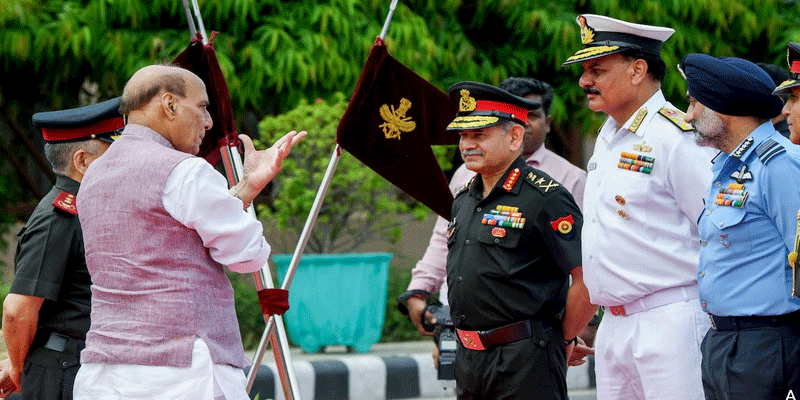
“India won’t tolerate nuclear blackmail” was among the strongest messages delivered by Defence Minister Rajnath Singh at News18 DefCon 2026, where he linked Operation Sindoor to a broader shift in India’s security doctrine. Invoking the Mahabharata and stressing the balance between diplomacy and military preparedness, Singh said India does not seek war but will not compromise its sovereignty or national security.
From Pahalgam to Operation Sindoor
Singh’s remarks come against the backdrop of the April 2025 Pahalgam terror attack and the subsequent military confrontation between India and Pakistan. India launched Operation Sindoor in May 2025, striking what it described as terrorist infrastructure in Pakistan and Pakistan-occupied Jammu and Kashmir.
At DefCon, Singh presented the operation as evidence of a changing Indian approach to deterrence. He said Pakistan had crossed a “Lakshman rekha” with Pahalgam and asserted that hostile action originating from Pakistani soil would be treated as an act of war and met with an appropriate response.
Mahabharata Analogy and Nuclear Deterrence
Invoking the Mahabharata, Singh recalled the Pandavas’ efforts to avoid conflict and their willingness to settle for five villages before the confrontation at Kurukshetra. His broader message was that India’s preference for peace and diplomacy should not be interpreted as unwillingness to defend itself.
He also reiterated that India would not tolerate nuclear blackmail, while maintaining that terrorism could not coexist with either dialogue or trade. Singh described this as part of a movement from “deterrence by denial” towards “deterrence by punishment.”
Defence Budget Nearly Triples
Singh connected the strategic shift with the expansion of India’s defence capabilities. He said the defence budget had risen from around ₹2.5 lakh crore in 2013–14 to ₹7.85 lakh crore in 2026–27, nearly a threefold increase.
The 2026–27 allocation includes:
· ₹2.19 lakh crore under the capital head.
· ₹1.39 lakh crore earmarked for procurement from domestic defence industries.
· A 24% increase in the capital-acquisition budget over the previous year.
The objective is increasingly tied to modernisation and self-reliance rather than simply higher spending.
Three Ts: Terrain, Technology and Thinking
Singh identified terrain, technology and thinking as crucial to modern warfare. He pointed to emerging domains including drones, artificial intelligence, cybersecurity, electronic warfare, space and quantum technologies.
He also highlighted the rise of indigenous defence production, which has reached approximately ₹1.80 lakh crore, reflecting the government's emphasis on Aatmanirbhar Bharat.
Diplomacy and Military Power Must Move Together
Singh also stressed that defence preparedness cannot operate independently of diplomacy. His formulation was that military preparedness without diplomacy can create confrontation, while diplomacy without adequate capabilities can be perceived as weakness. India, he said, therefore needs both strategic partnerships and credible military strength.
From Rhetoric to Real Strategic Capability
The DefCon address signals a broader evolution in India’s security messaging: restraint remains part of the doctrine, but deterrence is increasingly linked to the ability to impose costs on threats.
The real test will be implementation. Higher allocations must translate into deployable capabilities, faster procurement, stronger indigenous technologies and integrated responses across conventional and emerging domains. For India, the message from DefCon 2026 is therefore not simply about a tougher response to terrorism; it is about building the economic, technological and military capacity required to make that response credible.
(With agency inputs)