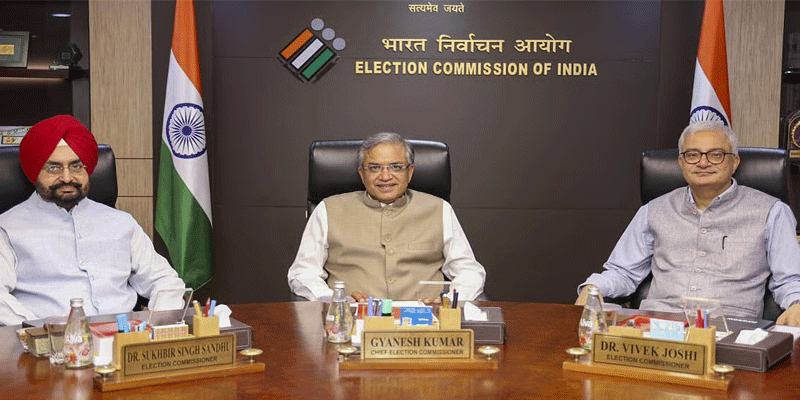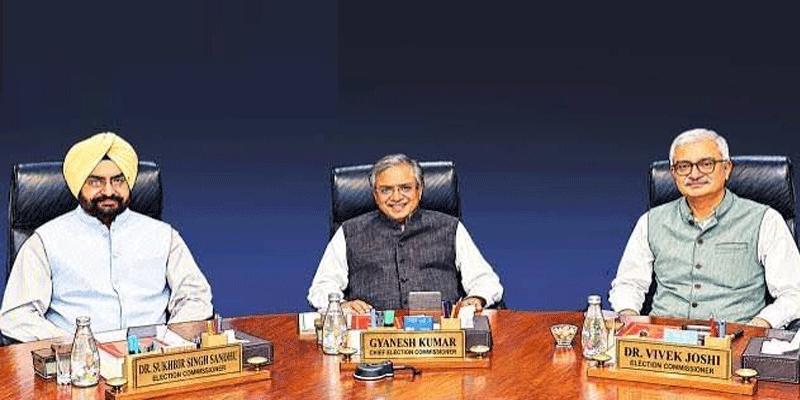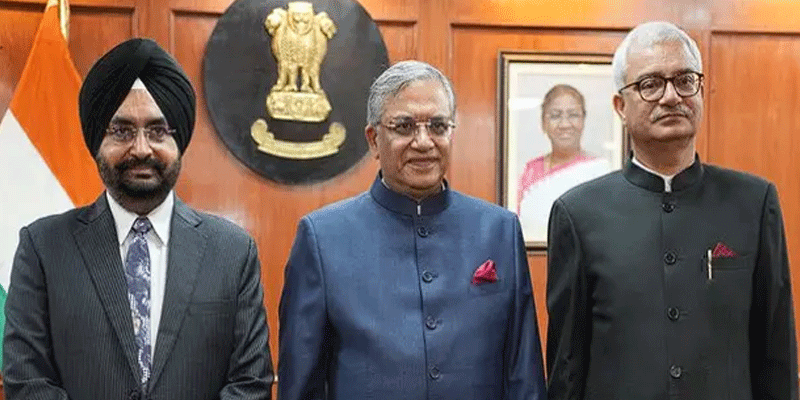
Opposition groups and the self-styled “Cockroach Janta Party” have demanded Chief Election Commissioner Gyanesh Kumar’s resignation after a newspaper investigation reported that Election Commissioners Sukhbir Singh Sandhu and Vivek Joshi had repeatedly questioned decisions concerning voter-list changes. The allegations have intensified an already contentious debate over the Special Intensive Revision (SIR) and the independence and functioning of the Election Commission of India.
Internal Dissent Puts Election Commission Under Scrutiny
The controversy centres on an Indian Express investigation that found Sandhu and Joshi had formally objected at least 14 times over 10 months to decisions they said were taken without their knowledge or approval. Their concerns reportedly covered new voter registration, deletion and restoration of names, electoral-roll software and access to the voter database. They described some actions as “unauthorised and illegal.”
The significance goes beyond an administrative disagreement. The objections reportedly involve core functions of the constitutional poll authority, including how electoral rolls are maintained and who exercises control over their underlying digital systems.
SIR Becomes the Centre of the Dispute
The Special Intensive Revision has already generated political controversy because of the large number of voter records being scrutinised across states.
A major flashpoint is Uttarakhand, where about 95,000 Form-7 deletion applications were automatically generated after voters classified as “ineligible” failed to provide required documents or attend hearings. The Chief Electoral Officer has clarified that “ineligible” does not permanently prevent inclusion: affected voters can seek inclusion through Form-6. The final roll is scheduled for publication on October 3.
Opposition parties, however, argue that procedural requirements and limited timelines could disproportionately affect vulnerable voters. The dispute therefore centres not only on deletion figures but also on whether safeguards and appeal mechanisms are sufficiently accessible.
CJP Escalates Demand Against CEC
The self-styled Cockroach Janta Party (CJP) has now brought the controversy onto the streets. Founder Abhijeet Dipke issued a 48-hour ultimatum demanding Kumar’s resignation and threatened a nationwide campaign, including a proposed “Jantar Mantar 2.0”.
Opposition parties have separately intensified protests and demanded greater scrutiny of the poll panel’s functioning. Congress has called for demonstrations at election offices and sought action against the CEC.
Experts See an Institutional Governance Question
Former Chief Election Commissioner O P Rawat has argued that constitutional authorities have established channels for raising grievances and questioned the decision of the two commissioners to approach the Cabinet Secretary rather than the President.
Meanwhile, the Indian Express investigation highlights a different institutional concern: whether decision-making and control over electoral databases are becoming increasingly centralised. It reported that the two commissioners objected to changes affecting oversight of the electoral-roll IT infrastructure.
These competing interpretations underline why the controversy cannot be reduced simply to a political confrontation.
Restoring Confidence Must Be the Priority
The immediate issue is not merely whether the CEC should resign, but whether the Election Commission can demonstrate that every change to voter registration, deletion procedures and electoral databases follows transparent, legally authorised and collectively accountable processes.
The reported dissent of two commissioners, the continuing SIR disputes and growing political protests have placed institutional credibility under unusual pressure. The Commission's response—through clear documentation, transparent procedures and effective avenues for voter appeals—will be crucial.
Ultimately, confidence in elections depends not only on the accuracy of electoral rolls but also on public confidence that no eligible voter is unfairly excluded and every decision can withstand independent scrutiny.
(With agency inputs)