From Ban Threats to Breakthrough
For years, TikTok’s future in the United States has been clouded by political battles, national security worries, and threats of an outright ban. Lawmakers in Washington raised alarms about the app’s Chinese ownership through ByteDance, warning it could be exploited for surveillance or influence campaigns. Former President Joe Biden even signed legislation last year forcing ByteDance to sell TikTok’s U.S. assets or face expulsion from the American market.
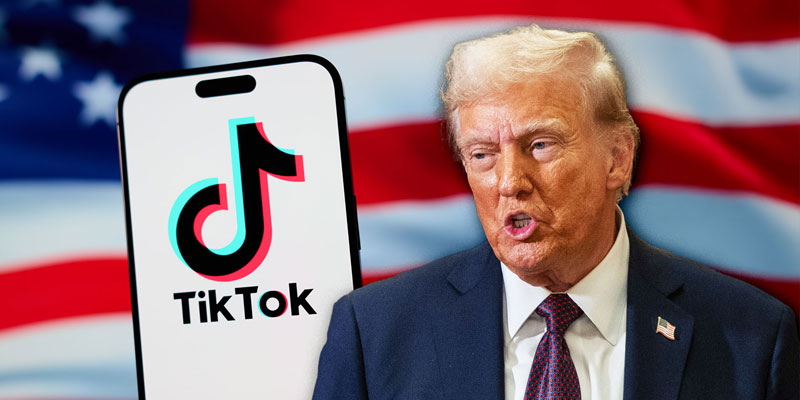
Against this tense backdrop, Donald Trump has now signed an executive order approving a new ownership deal that could resolve the deadlock. The move not only spares TikTok from a nationwide shutdown but also redefines the app’s governance structure, giving American investors a controlling hand.
Trump’s Executive Order
On Thursday, Trump announced that the proposed agreement “satisfies U.S. national security concerns,” effectively greenlighting the restructuring. According to the White House, TikTok’s U.S. business will be spun into a new joint venture valued at $14 billion. While the valuation raised eyebrows—especially since ByteDance recently pegged its worth above $330 billion—the order gives the video-sharing giant a lifeline in its most lucrative foreign market.
Trump said Chinese President Xi Jinping had given his blessing to the arrangement. “They’re on board,” he told reporters, even joking that if left to him, TikTok would become “100% MAGA.”
Structure of the New Venture
Under the deal, American investors are expected to hold roughly 80% of TikTok’s U.S. arm, with ByteDance retaining 20% or less. Governance will be firmly weighted toward U.S. control: board seats will mostly go to American shareholders, while ByteDance will have only one representative—and none on national security committees.
Among the prominent investors are Oracle and Silver Lake, who together are slated to own nearly half of the U.S. unit. Media mogul Rupert Murdoch and Dell founder Michael Dell are also reported to be part of the investor pool. Oracle’s Larry Ellison, a long-time Trump ally, is expected to play a central role, having already proven influential in major technology and media deals.
Questions Around the Algorithm
Despite the clarity on ownership, the most sensitive issue—the control of TikTok’s algorithm—remains murky. Vice President J.D. Vance insisted that the new structure guarantees American oversight of the algorithm, which determines what content users see. “We don’t want this used as a propaganda tool by any foreign government,” Vance stressed.
But skeptics are not fully convinced. Alan Rozenshtein, a law professor at the University of Minnesota, noted that Trump’s order leaves critical questions unanswered: “The president has certified the deal, but he has not provided a lot of information on the algorithm.”
Meanwhile, Chinese media reports suggest ByteDance will retain meaningful operational influence. Outlets like LatePost and Caixin claim that ByteDance will create a new U.S. company handling e-commerce, branding, and integration with its global operations—an arrangement that could leave it with some revenue streams even after ceding control.
A Political Win for Trump
The deal also carries political undertones. TikTok has 170 million users in the U.S., including more than 15 million followers of Trump’s own account. The app played an unexpected role in energizing his re-election campaign, and the White House only recently opened an official TikTok account of its own. Saving the app while ensuring American ownership allows Trump to claim both a national security victory and a political advantage.
Uncertainty Amid Resolution
Trump’s order marks a major turning point in TikTok’s fraught U.S. journey, removing the immediate threat of a ban and giving the app room to grow under a new American-led ownership model. Yet questions persist. Will ByteDance still wield influence through indirect operations? Who truly commands the algorithm? And can the joint venture satisfy both Washington’s security concerns and Beijing’s commercial interests?
For now, TikTok users can breathe a sigh of relief, and investors can prepare for a high-stakes restructuring. But the story is far from over. The app remains a geopolitical flashpoint, and the success of this deal will depend not only on financial ownership but also on transparency, trust, and the careful balancing of two superpowers’ interests.
(With agency inputs)