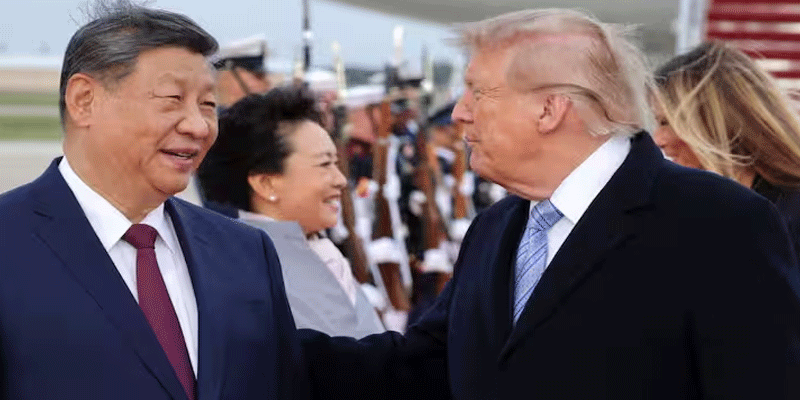
Trade, Taiwan and a whole lot of pageantry defined the September 23–25, 2026 state visit of Chinese President Xi Jinping to Washington, his first US state visit in more than a decade. President Donald Trump gave Xi an unusually grand welcome, including a rare airport reception, military honours and a White House state dinner attended by leading technology executives. Beneath the ceremony, however, the summit exposed the continuing limits of the US-China rapprochement.
A Summit Designed to Stabilise, Not Reset
The meeting followed years of tariff disputes, technology restrictions and strategic rivalry. Both leaders therefore sought to project stability. Xi spoke of the two countries as partners rather than rivals and argued that China’s national rejuvenation and Trump’s “Make America Great Again” agenda could coexist. Trump, meanwhile, described the talks positively and highlighted his personal relationship with Xi.
Yet analysts had already cautioned that the summit was more likely to manage tensions than produce a sweeping reset.
Trade Truce Buys Time, But Hard Issues Remain
The clearest economic outcome was an extension of the existing trade truce, giving Washington and Beijing additional time to negotiate. But major disputes remain over tariffs, Chinese purchases of US goods, rare-earth supplies and technology controls.
For global businesses, the extension reduces immediate uncertainty. It does not, however, remove the structural rivalry shaping supply chains and investment decisions.
Taiwan Remains the Strategic Red Line
Taiwan remained among the most sensitive issues. Beijing continued to press Washington to oppose Taiwanese independence and handle the issue cautiously, while the US position showed no fundamental shift. The absence of a new confidence-building arrangement means Taiwan remains a major potential flashpoint despite the leaders’ emphasis on stability.
AI Reveals a New Divide
Artificial intelligence has emerged as another arena of strategic competition. Trump has resisted additional AI restrictions, while Xi has stressed that AI should remain under human control and be developed for public benefit. The disagreement reflects fundamentally different approaches to technological governance even as both countries recognise AI’s enormous economic and security importance.
Why India Is Watching Closely
For India, the summit matters well beyond Washington and Beijing.
· China+1: A prolonged US-China confrontation has encouraged companies to diversify manufacturing towards India. Greater US-China stability could reduce some of that urgency, although supply-chain diversification is unlikely to disappear.
· Semiconductors and AI: Any relaxation of technology restrictions could alter competitive conditions as India expands its semiconductor and AI ecosystem.
· Critical minerals: Rare-earth access remains strategically important for India's manufacturing, electronics and clean-energy ambitions.
· Indo-Pacific security: Any deterioration over Taiwan could affect shipping, regional security and India's wider strategic calculations.
· India-China relations: Xi's recent New Delhi visit and engagement with Prime Minister Narendra Modi make the Washington summit particularly relevant to India's balancing between economic engagement and strategic caution.
The Real Test Begins After the Cameras
The Trump-Xi summit has produced a warmer diplomatic atmosphere and more time for negotiations, but not a settlement of the core disputes. Trade has been temporarily stabilised, while Taiwan, technology, AI and strategic competition remain unresolved.
For India, the message is equally significant: US-China stability can support global growth, but New Delhi's economic and strategic interests cannot depend on rivalry between the world's two largest powers. The real measure of this summit will therefore be whether its carefully choreographed pageantry evolves into durable agreements—or merely postpones the next confrontation.
(With agency inputs)