A Red Line Drawn: Zelenskyy’s Firm Stand
Ukrainian President Volodymyr Zelenskyy has emphatically rejected any proposal to cede Ukrainian territory to Russia — even as he presses European capitals for backing and security guarantees ahead of a peace framework being pushed by the United States. In a recent media interaction, Zelenskyy declared that Ukraine will not surrender land that is theirs by law or morality — underscoring that sovereignty and constitutional integrity remain non-negotiable.
As the pressure mounts from Washington and Moscow to finalise a “compromise,” Zelenskyy is touring Europe to rally support, coordinate a unified stance with allies, and reinforce the message that Ukraine will not barter its territorial integrity for peace.
What’s Driving the Diplomatic Surge
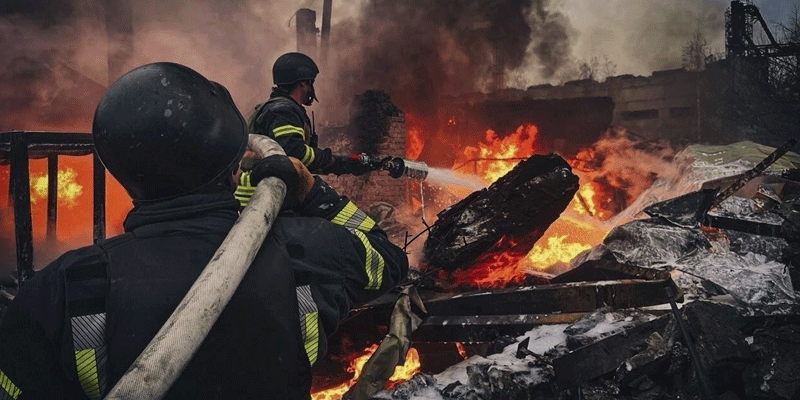
Since Russia’s full-scale invasion in 2022, Ukraine has lost large swathes of territory, including parts of Donbas, Crimea, Kherson and Zaporizhzhia. As war drags into its fourth year, the U.S. – under the persuasion of key envoys — is reportedly pushing a draft peace plan seeking to end hostilities through a “painful compromise.” The proposal, circulated under a 28-point framework, earlier proposed for Kyiv to surrender control over the entire Donbas region and parts of other occupied zones.
While Ukraine initially engaged in talks, many of those terms now clash directly with Zelenskyy’s publicly declared red lines. The Ukrainian leadership fears that ceding territory under duress would amount to capitulation — something constitutionally and morally unacceptable.
What the U.S. Peace Proposal Proposes
The U.S.-backed draft deal is anchored on several controversial components:
· Territorial Concessions: Full de facto control for Russia over Donbas (Donetsk and Luhansk), recognised control over Crimea, and frozen lines of control in Kherson and Zaporizhzhia. Some versions even call for withdrawal from areas still held by Kyiv.
· Military Restrictions for Ukraine: Kyiv would be required to reduce its armed forces to around 600,000 — well below present wartime strength — and give up certain long-range weapons systems, substantially limiting its defensive and offensive capabilities.
· Security Guarantees & Neutrality Terms: Ukraine must constitutionally renounce future NATO membership; Western troops would be barred from Ukrainian soil. In return, the U.S. and some allies would offer security guarantees — conditional, often vague, and reportedly contingent on Kyiv not attacking Russia or crossing certain red lines.
· Economic Reconstruction and Russian Re-integration: The plan envision using frozen Russian assets to finance reconstruction in Ukraine. In exchange, Russia could be gradually restored to global economic forums like the G8 and benefit from loosening sanctions, creating incentives for Moscow to accept the deal.
Critics argue the plan demands “maximal concessions” from Ukraine while offering only conditional and uncertain guarantees — a trade many see as unacceptable and dangerous for long-term sovereignty.
Sovereignty Over Compromise, At What Cost?
Zelenskyy’s public, unified rejection puts Ukraine at cross-roads: accept a U.S.-backed settlement that freezes Russian territorial gains and imposes military constraints or continue fighting for full restoration of sovereignty, enduring prolonged war and uncertainty. By rallying European backing and refusing to barter territory, Kyiv is betting on solidarity from allies, persistent military resistance, and long-term strategic strength.
But this stance carries risks. If Western support frays, military aid dries up, or Russia intensifies its campaign, Ukraine may face widening hardship. Still, from a sovereignty perspective, ceding territory under pressure may undermine national dignity, territorial integrity, and set a dangerous precedent for future conflicts. For now, Zelenskyy signals that Ukraine values sovereignty over uncertain peace, even if the path forward grows steeper.
(With agency inputs)