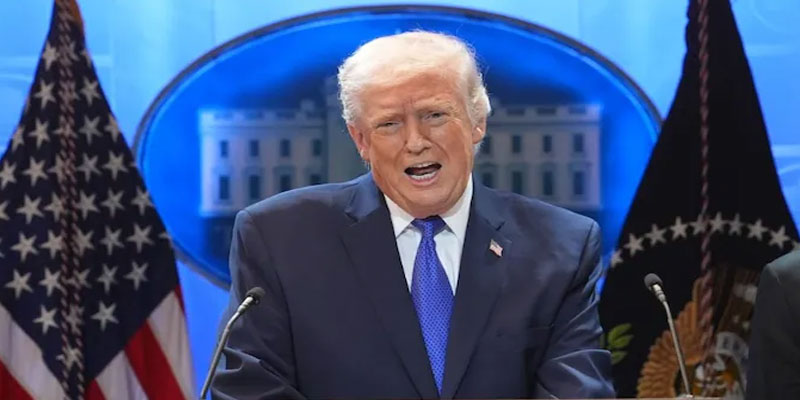
US President Donald Trump has said there is “no change” in the trade agreement with India, hours after the Supreme Court of the United States struck down his sweeping global tariffs. Speaking at the White House, Trump asserted that the “India deal is on” and described the revised arrangement as fair to Washington.
Trump praised his relationship with Prime Minister Narendra Modi, calling it “fantastic” and “great.” He said the new framework flips previous trade dynamics, claiming that India would now pay tariffs while the US would not.
Key facts from current reports:
The US Supreme Court ruled 6-3 that Trump's sweeping global tariffs (imposed under the International Emergency Economic Powers Act, or IEEPA) were unlawful, as the law does not authorize the president to impose such broad import duties. This struck down many of his "reciprocal" and emergency-based tariffs, potentially opening the door to billions in refunds for importers.
In response, Trump quickly imposed a new 10% global tariff under a different legal authority (Section 122 or similar trade laws), calling the court's decision "terrible" and criticizing the justices.
Regarding India specifically: An interim trade framework was announced earlier in February 2026 (around February 2), where the US reduced tariffs on Indian goods from higher punitive levels (e.g., 25% or up to 50% in some contexts, including penalties tied to India's Russian oil purchases) to 18%. In exchange, India committed to reducing/ending Russian oil imports, increasing purchases of US energy, and other concessions.
After the Supreme Court ruling, Trump stated at a White House event that there is "no change" to the India deal: "The India deal is on." He described it as "fair," with India paying tariffs (now effectively adjusted in the new context) while the US does not pay tariffs to India—a "flip" from prior dynamics. He praised his "fantastic" relationship with Prime Minister Narendra Modi, calling him a "great" and "smart" leader.
However, due to the court's invalidation of the prior IEEPA-based tariffs and the new 10% global tariff, reports indicate India's effective tariff rate on exports to the US has been adjusted downward to 10% (temporarily replacing the 18% under the deal framework for countries with prior agreements). White House clarifications note that pre-existing trade deal concessions are expected to hold, but the new blanket 10% applies in the interim until further actions.
Trump also referenced past claims that his tariff threats helped de-escalate India-Pakistan tensions (though this remains his assertion without broad independent confirmation in recent coverage).
Earlier this month, Washington and New Delhi announced an interim trade framework under which reciprocal tariffs on India were reduced from 25% to 18%. Trump also signed an executive order removing punitive tariffs linked to India’s purchases of Russian oil, citing India’s commitment to reduce energy imports from Moscow and expand US energy purchases.
The US President reiterated his claim that tariffs were instrumental in easing tensions between India and Pakistan last year. He stated that he had threatened both countries with 200% tariffs if hostilities continued, asserting that the move helped prevent escalation.
Despite the Supreme Court’s ruling against his broader tariff regime, Trump emphasized that the India agreement remains intact. “Nothing changes,” he said, adding that the administration would continue to pursue trade deals “in a different way.”
The remarks signal continuity in US-India trade engagement even as legal challenges reshape Washington’s global tariff strategy.