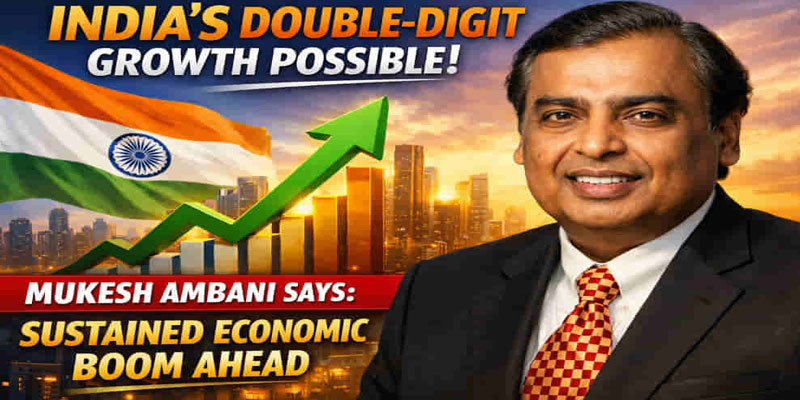
BlackRock CEO Larry Fink on Wednesday delivered an emphatic endorsement of India’s long-term economic prospects, declaring that “this is the era for India” and urging millions of citizens to invest alongside the nation’s ascent. Sharing the stage with Reliance Industries Chairman Mukesh Ambani, the discussion centered on India’s sweeping economic ambitions — including a potential expansion toward a $30 trillion economy over the coming decades — powered by technology, capital markets, and artificial intelligence.
A Convergence of Capital and Technology
The remarks reflect growing global confidence in India as a central engine of future growth. Ambani and Fink framed the country’s trajectory as a rare opportunity shaped by demographic strength, digital infrastructure, and accelerating adoption of AI. As the global economy is expected to expand dramatically in the coming decades, both leaders argued that India could secure a disproportionate share of new value creation if it mobilizes domestic investment and embraces productivity-enhancing technologies.
A Vision of Scale and Structural Expansion
Ambani projected that India could generate roughly $30 trillion in additional economic value over the next thirty years, potentially lifting its GDP from about $4.5 trillion today to the mid-$30 trillion range. He described the task as comparable to building “dozens of new Reliances,” emphasizing that entrepreneurs and startups would play a decisive role in scaling innovation. The argument rests on sustained high growth combined with digital infrastructure and manufacturing expansion, allowing India to move from consumption-driven growth toward a production-led model.
Artificial Intelligence as a Productivity Multiplier
Central to the outlook is the transformative role of artificial intelligence. Ambani suggested AI could deliver dramatic productivity gains across industries, from energy and retail to telecommunications and healthcare. With a vast young workforce and rapid digital adoption, India is positioned to deploy AI at scale in public services, education, and enterprise. Fink echoed this sentiment, warning that underinvestment could allow competing economies to pull ahead. He stressed that robust capital markets and regulatory oversight give India an advantage in enabling retail investors to participate in technology-driven growth.
Capital Markets and Investment Mobilization
A key theme of the discussion was the need to channel household savings into productive assets. Fink advocated deeper capital market participation to finance infrastructure, startups, and AI-related investments. BlackRock plans to expand its operational footprint in India, adding engineering and data talent to support AI-driven investment research and analytics. Strategic partnerships with Indian firms, including joint ventures aimed at broadening retail investment access, are intended to connect domestic savings with long-term growth sectors. Such moves could reduce reliance on volatile foreign inflows while strengthening local wealth creation.
Opportunities and Structural Challenges
Despite the optimism, structural hurdles remain. Infrastructure bottlenecks, regulatory evolution, and skill development gaps could constrain growth if not addressed. Ambani emphasized the importance of conviction and scale in overcoming these obstacles, positioning Reliance as an “AI-first” enterprise investing heavily in data centers, partnerships, and digital ecosystems. For global investors, India’s sustained growth on a large base — a rarity among major economies — enhances its appeal as a long-term destination for patient capital.
Aligning Vision with Execution
The convergence of global capital and domestic ambition signals a pivotal moment for India’s economic trajectory. Fink’s call for widespread participation in the investment story and Ambani’s projection of multi-trillion-dollar expansion together underscore the magnitude of the opportunity. Realizing this vision will depend on sustained policy support, infrastructure investment, and broad-based financial inclusion. If these elements align, India could emerge not only as a fast-growing economy but as a central pillar of global growth in the decades ahead.
(With agency inputs)