Tatarstan Drone Strike Signals Ukraine War’s Wider Escalation
A Deadly Strike Deep Inside Russia
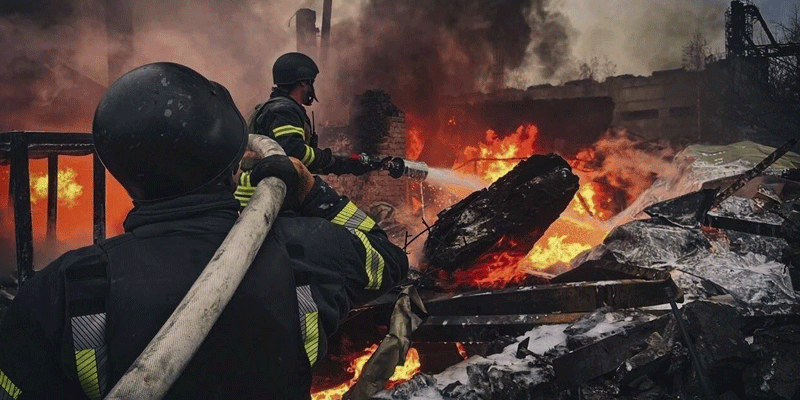
The Russia–Ukraine war has entered another dangerous phase after a Ukrainian drone strike hit Nizhnekamsk in Russia’s Tatarstan region on Monday, leaving at least 13 people dead and 75 injured, according to updated reports cited by the Associated Press and BBC. Earlier Russian figures had put the toll at 12 dead and 39 wounded. The changing numbers reflect continuing emergency operations, but the attack is already among the deadliest Ukrainian strikes inside Russia since the full-scale war began.
Its significance extends beyond casualties. Nizhnekamsk is more than 1,000 kilometres from Ukraine and houses major industrial infrastructure, including the strategically important TANECO oil refinery operated by Tatneft. The refinery processed around 17 million tonnes of crude in 2024, making the facility important to Russia’s fuel economy.
Why Ukraine Is Striking Deep Inside Russia
Ukraine’s expanding long-range drone campaign reflects a deliberate strategy to take the war beyond the battlefield. Kyiv increasingly targets refineries, fuel depots, military-industrial facilities and logistics hubs that contribute directly or indirectly to Russia’s war effort.
The objective is multifaceted: disrupt fuel supplies, increase economic costs, damage industrial capacity and demonstrate that Russia’s supposedly secure rear areas remain vulnerable. Recent attacks on refineries in Bashkortostan, Yaroslavl, Krasnodar and Samara underline the broader pattern.
Russia’s Defence Ministry said 456 Ukrainian drones were destroyed overnight. If accurate, the figure demonstrates the sheer scale of drone warfare and how inexpensive, remotely operated systems are reshaping the strategic geography of the conflict.
Tatarstan Raises the Strategic Stakes
The distance of Tatarstan from Ukraine makes the strike particularly notable. Hitting an industrial centre so far from the front suggests that Ukraine is increasingly capable of reaching critical Russian infrastructure deep within the country.
For Moscow, this creates a difficult security challenge. Protecting every refinery, industrial complex and logistics hub requires substantial air-defence resources, potentially stretching systems already needed near the front. Any disruption to refining capacity could also affect fuel availability and increase pressure on Russia’s economy.
Kharkiv Shows the War’s Brutal Symmetry
While Ukraine struck deep into Russia, Russian attacks continued against Ukrainian communities. In northeastern Kharkiv region, Russian artillery reportedly struck the residential area of Buhaivka in Chuhuiv district, killing five people and destroying homes. Ukrainian authorities opened a pre-trial investigation on suspicion of a war crime.
The contrasting attacks capture the conflict’s expanding character: Ukraine is increasingly projecting force into Russia, while Russia continues using artillery, drones and glide bombs against communities near the battlefield.
A Wider War with Fewer Geographic Limits
The immediate response is likely to include stronger Russian air defences around strategic industrial facilities and possible retaliatory attacks against Ukrainian infrastructure. Moscow could also use the Russian casualties to reinforce domestic support for prolonged military operations.
Diplomatically, the strikes make a ceasefire more difficult. Both sides appear determined to strengthen their bargaining positions through military pressure, yet every successful deep strike risks provoking another round of retaliation.
The Battlefield Is No Longer the Boundary
The Tatarstan attack demonstrates that the war’s strategic map is expanding faster than its diplomatic prospects. As drones increasingly turn distant industrial centres into potential battlefields, the conflict is becoming harder to contain—and every new deep strike raises the danger that escalation will outrun negotiations.
(With agency inputs)