A Date That Holds More Than History
For most of the world, 14 August is just a mark on the calendar. But for India, it is an indelible scar — the eve of Independence that also carried the unbearable weight of Partition. The jubilant dawn of freedom on 15 August 1947 was preceded by a night of bloodshed, displacement, and human tragedy that reshaped the subcontinent forever. The political decisions and sectarian divides of that time uprooted millions, tore apart centuries-old bonds, and left behind a pain that still echoes in the nation’s collective memory.
It is for this reason that India observes Partition Horrors Remembrance Day every year on 14 August — not merely as a historical reminder, but as a solemn tribute to those who endured the unimaginable.
Remembering the Unseen Sufferers
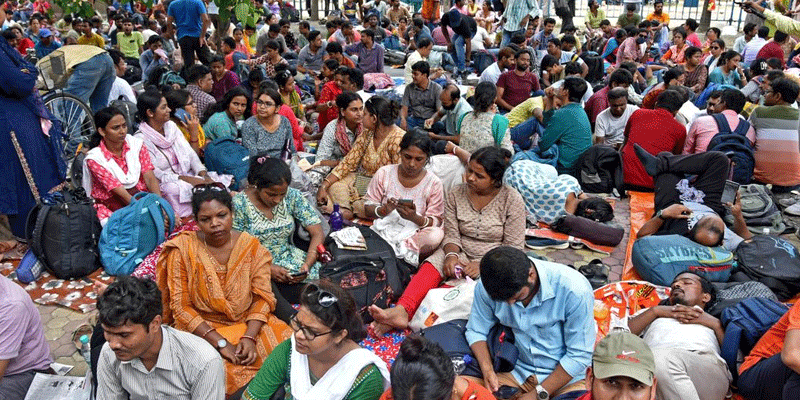
The newly liberated India was born amidst chaos. Entire communities were displaced overnight; families fled ancestral homes, often leaving with nothing but what they could carry. Violence swept across regions, fueled by hatred and mistrust. Countless men, women, and children — many nameless and forgotten — were killed in riots or perished during desperate journeys across the new borders.
On this day, tributes pour in from across the nation for the displaced, the martyrs, and the silent victims whose stories never reached history books. Their sacrifice is the foundation of modern India’s resilience, and their suffering is a reminder of the price paid for freedom.
Leaders Speak: Lessons from the Past
Uttar Pradesh Chief Minister Yogi Adityanath called 14 August “not just a date, but a tragedy” in Indian history. In a heartfelt message, he recalled that the very night before India’s first Independence Day was marked by “narrow religious fanaticism and policies of hatred” that divided the nation, leading to riots, massacres, and untold misery. He urged citizens to remember the pain as both a memory and a lesson — a vow that no generation should be forced to endure such agony again.
Deputy Chief Minister Keshav Prasad Maurya described Partition as “the most heart-breaking tragedy in the history of India,” a harrowing chapter of violence, displacement, and the loss of identity. He called this day an opportunity to remember all those who lost not only their homes and families but also their very sense of belonging.
From Uttarakhand, Chief Minister Pushkar Singh Dhami echoed the sentiment, emphasizing that the “line of communal division” inflicted deep wounds on the soul of the country. Millions were stripped of their livelihoods, memories, and heritage, yet many displayed remarkable courage in the face of despair. For him, Partition is not just a historical event — it is “an eternal pain imprinted in our national consciousness.”
The Decision to Institutionalize Memory
The idea of officially commemorating Partition’s horrors came in August 2021, when the Government of India declared 14 August as Partition Horrors Remembrance Day. The announcement, made by Prime Minister Narendra Modi, aimed to ensure that present and future generations never forget the suffering endured by those caught in the upheaval.
In his statement, the Prime Minister said, “Partition’s pains can never be forgotten. Millions of our sisters and brothers were displaced and many lost their lives due to mindless hate and violence.” He hoped that marking this day would serve as a reminder to eliminate the poison of division, foster harmony, and strengthen the unity of the nation.
Why This Day Matters
Commemorating 14 August is not about reopening old wounds but about acknowledging them so they can heal. It is a conscious effort to keep alive the stories of resilience, endurance, and humanity that emerged even from one of history’s darkest moments. The observance serves as both a memorial and a moral compass — urging India to guard against intolerance and work tirelessly toward social harmony.
Pain as a Teacher
The tragedy of Partition was not just a political division; it was a human catastrophe that reshaped millions of lives. 14 August is therefore not an ordinary date — it is a solemn reminder that the unity of a nation is fragile if undermined by hatred. As India remembers the displaced, the fallen, and the forgotten, it also renews its pledge: never again should communal divides dictate the destiny of its people.
In remembering the past with honesty, the nation safeguards its future with wisdom.
(With agency inputs)