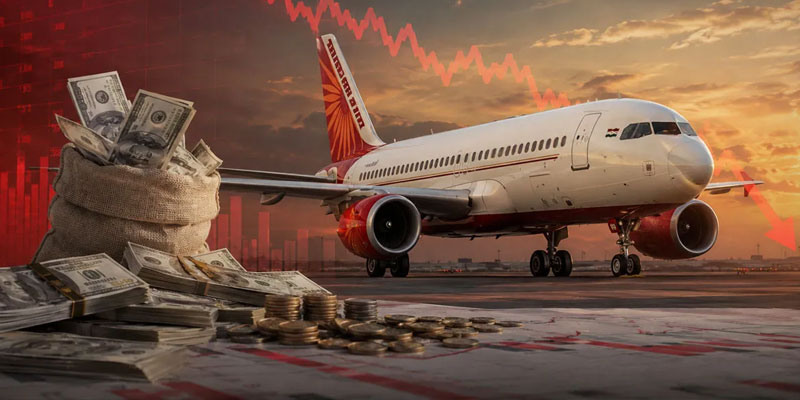
A Capital Call Amid Mounting Losses
Air India’s request for about 1.5 billion in fresh equity from Tata Sons and Singapore Airlines has become a critical test of its ambitious turnaround. The funding, which has reportedly not yet been approved, comes as the airline confronts mounting losses, expensive fleet renewal and disruptions to the international network. For its owners, the question is no longer simply how much capital Air India needs, but whether additional funding can convert a costly transformation into a sustainable airline.
From Privatisation to Transformation
Tata Group regained control of Air India from the Indian government in 2022 and subsequently merged it with Vistara, giving Singapore Airlines a 25.1% stake in the enlarged group. The owners inherited a legacy carrier burdened by ageing aircraft, fragmented technology, uneven customer experience and persistent losses.
The group launched the Vihaan.AI transformation programme, centred on aircraft purchases, fleet refurbishment, network restructuring, digital upgrades and workforce integration. The latest funding proposal would reportedly be released in tranches. On a proportional basis, Tata Sons could contribute around 1.12 billion, while Singapore Airlines’ share would be approximately 380 million.
Singapore Airlines’ participation is particularly significant because its board has indicated that any further funding would be assessed against its wider capital requirements and Air India’s strategic direction.
The Scale of Air India’s Losses
The precise loss figure requires careful interpretation. Reuters has reported combined Air India and Air India Express losses of about 2.33 billion for the year ended March, more than twice the previous year’s deficit. Singapore Airlines’ annual report, using its accounting treatment, recorded Air India’s loss after tax at S$3.77 billion, with its share of losses at S$945.2 million.
The differing figures underline the importance of comparable financial disclosure. Yet the central message remains unchanged: the turnaround is consuming capital faster than the airline is generating it.
Fresh equity would help fund aircraft induction and retrofits, engines, maintenance, technology, training, product improvements and working capital. It also offers greater protection than excessive borrowing against fuel-price, currency and demand shocks.
External Pressures Complicate the Revival
Air India’s financial recovery has also been hit by geopolitical disruptions. Pakistan’s continued ban on Indian airlines using its airspace since April 2025 has forced longer routes, increasing fuel and crew costs.
The Israel-Iran conflict has compounded the problem by restricting airspace across important international corridors. Air India subsequently cut more than a quarter of its international flights from June, while DGCA data showed its international passenger traffic falling sharply during April-June.
These disruptions strike directly at Air India’s long-haul strategy, where network breadth is central to the group’s transformation.
Capital Alone Cannot Deliver the Turnaround
The proposed funding can protect the transformation timetable and reassure suppliers, employees and investors. But money cannot substitute for operational discipline.
Air India must translate its larger fleet into higher aircraft utilisation, better punctuality, stronger premium revenues and improved customer experience. The integration with Air India Express and Vistara must also deliver measurable cost efficiencies, while network decisions should separate strategically important routes from structurally uneconomic ones.
Ultimately, the funding request is a vote of confidence in Air India’s ownership model—but also a demand for accountability. Tata’s financial strength and Singapore Airlines’ aviation expertise provide a powerful foundation. Yet repeated capital injections must be tied to clear milestones on cash burn, productivity, costs and service quality. The real turnaround begins when fresh equity stops financing losses and starts financing sustainable growth.
(With agency inputs)