The Sensex crashed more than 1,000 points intraday on Thursday, while the Nifty 50 fell below 22,300 as investors reacted sharply to rising crude prices, the Reserve Bank of India’s more hawkish policy stance and persistent foreign selling. The sell-off extended the weakness seen on Wednesday, when the Sensex had declined 429 points and the Nifty 173 points after a two-session relief rally.
From Relief Rally to Broad-Based Sell-Off
The market had entered the week on a relatively stronger footing after gains in the previous two sessions. But Wednesday’s decline signalled that investor confidence remained fragile. Thursday’s sharper fall showed that multiple domestic and global risks were now converging.
By Thursday, the pressure had spread across several sectors, indicating that the decline was broader than isolated profit-taking.
Five Reasons Why the Market Is Falling
1. RBI’s Hawkish Policy Shift
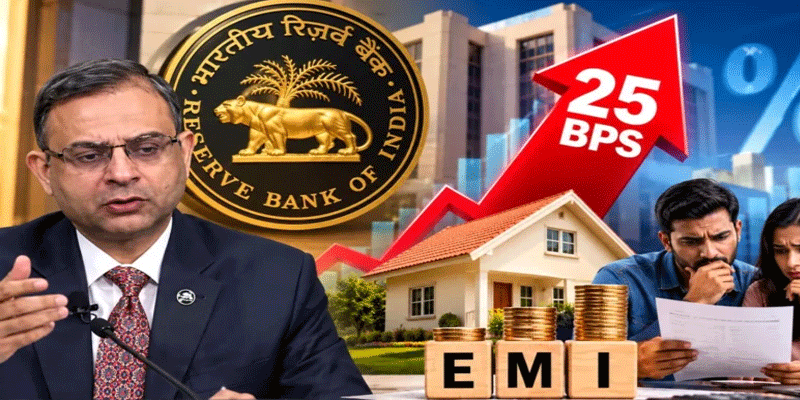
The RBI raised the repo rate by 25 basis points to 5.50% on Wednesday and changed its stance from “neutral” to “calibrated tightening”. It was the first-rate increase since February 2023. The shift signalled that inflation risks could keep monetary policy restrictive for longer. Higher borrowing costs can weigh on rate-sensitive sectors such as automobiles, real estate and consumer finance.
2. Crude Oil Surges Above $100
Brent crude climbed above $102 a barrel, with prices subsequently moving above $104 amid concerns over Middle East supply disruptions. For an oil-importing economy such as India, expensive crude can increase inflationary pressure, widen the import bill and squeeze corporate margins while putting additional pressure on the rupee.
3. Heavy Foreign Investor Selling
Foreign institutional investors sold Indian equities worth about ₹6,121 crore on October 7, while domestic institutions bought around ₹4,597 crore. Persistent foreign outflows can weigh on large-cap stocks, the rupee and overall market sentiment.
4. Global Yields and Risk Aversion
Rising US Treasury yields and broader global risk aversion are making dollar-denominated assets relatively more attractive. Weakness across Asian markets has added to the negative global backdrop for Indian equities. Higher global yields can also reduce the appeal of emerging-market stocks.
5. Geopolitical and Earnings Uncertainty
West Asia tensions are raising concerns over energy supplies, shipping costs and inflation. At the same time, investors are entering the September-quarter earnings season with heightened expectations. The combination of geopolitical uncertainty and questions over corporate margins is encouraging investors to reduce risk.
A Collision of Risks, Not Just a Market Correction
Thursday’s sell-off reflects several pressures reinforcing one another: higher oil prices, tighter monetary policy, foreign outflows, elevated global yields and geopolitical uncertainty. The weakening rupee adds another layer of concern because expensive imports can intensify inflationary pressures.
Yet the fall does not necessarily signal a collapse in India’s underlying economic fundamentals. The RBI has also raised its FY27 growth projection to 7.1%, indicating that policymakers continue to see strong domestic economic activity.
The immediate market direction will depend on whether crude prices stabilise, foreign selling moderates and corporate earnings provide reassurance. Until those pressures ease, volatility is likely to remain the defining feature of Dalal Street.
(With agency inputs)