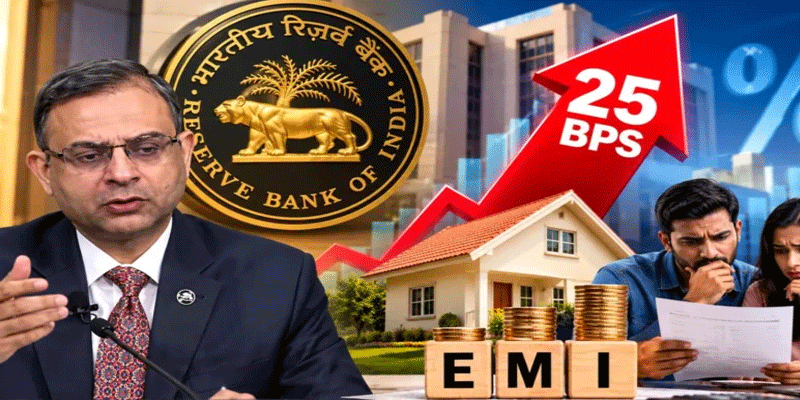
The Reserve Bank of India (RBI) has increased the policy repo rate by 25 basis points to 5.50 per cent, marking its first rate hike since February 2023. The unanimous decision of the six-member Monetary Policy Committee (MPC), chaired by Governor Sanjay Malhotra, also shifts the policy stance from “neutral” to “calibrated tightening”, signalling greater vigilance over inflation even as the RBI raised its FY27 GDP growth forecast from 6.7 per cent to 7.1 per cent.
Repo Rate: The Key Monetary Policy Lever
The repo rate is the interest rate at which the RBI lends short-term funds to commercial banks against government securities. It is one of the central bank’s principal tools for managing inflation, credit conditions and economic stability.
When the repo rate rises, banks’ cost of funds can increase, potentially pushing up lending rates. This makes borrowing more expensive, moderates demand and can help prevent inflation from becoming entrenched.
India’s inflation-targeting framework aims to keep consumer-price inflation at 4 per cent, with a tolerance range of 2-6 per cent. The latest increase therefore reflects the RBI’s decision to give greater priority to inflation risks despite continued economic momentum.
Why the RBI Has Turned More Cautious
The rate increase comes against a less comfortable inflation outlook. Consumer-price inflation rose to 4.82 per cent in August from 4.45 per cent in July, while several factors could generate additional pressure.
Key risks include:
· Weather uncertainty and deficient monsoon conditions, which could affect food supplies.
· El Niño-related risks that may influence agricultural output and prices.
· Volatile international crude oil prices, with implications for transport and production costs.
· Higher input costs potentially passing through to goods and services.
· The possibility of inflation expectations becoming more persistent.
The RBI’s revised inflation outlook indicates that policymakers are looking beyond temporary food-price fluctuations. A modest rate increase now could help prevent the need for more aggressive monetary tightening later.
From Neutral to Calibrated Tightening
The shift from a neutral stance to calibrated tightening is an important part of the decision. A neutral stance leaves the central bank free to raise, reduce or maintain rates depending on economic conditions.
Calibrated tightening, however, signals a more restrictive policy bias. It does not guarantee another rate increase, but indicates that inflation control will remain a priority. The unanimous MPC vote further strengthens the credibility of that message.
What It Means for Borrowers
The immediate impact is likely to be felt most clearly by borrowers with floating-rate loans. A full 25-basis-point transmission could increase the interest rate on repo-linked housing and auto loans by 0.25 percentage point.
Borrowers could experience:
· Higher EMIs;
· Longer repayment periods; or
· A combination of both.
The impact will vary according to the loan's benchmark and reset terms. Fixed-rate borrowers are generally insulated from this particular move.
Balancing Growth with Price Stability
The RBI’s decision reflects a delicate economic calculation. Higher rates can restrain consumption and investment, but allowing inflation to remain elevated for too long can erode household purchasing power and eventually weaken growth.
With GDP growth still projected at a robust 7.1 per cent, the RBI appears willing to accept some near-term borrowing pressure to reinforce price stability.
A Small Hike with a Larger Message
The 25-basis-point increase is modest, but its message is significant: the RBI is prepared to act early rather than wait for inflationary pressures to become entrenched. With growth remaining resilient, calibrated tightening gives the central bank room to protect purchasing power while avoiding unnecessarily sharp monetary intervention.
The challenge now will be to maintain that balance—containing inflation without choking the investment, consumption and growth momentum that India needs for sustained expansion.
(With agency inputs)