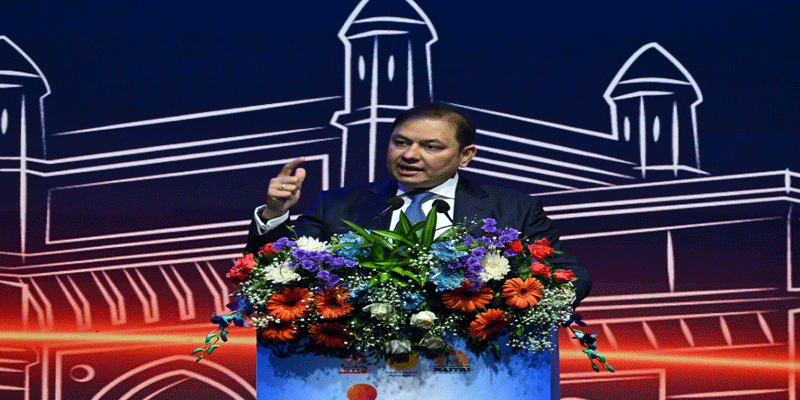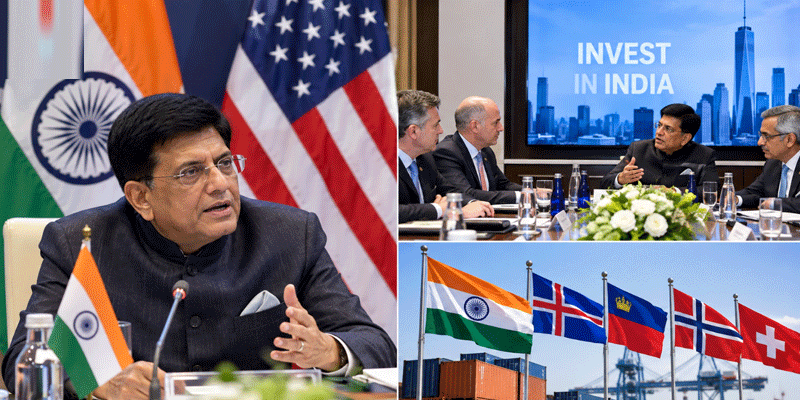
Commerce and Industry Minister Piyush Goyal’s meetings with leading American business leaders in New York underline India’s effort to keep investment and commercial engagement moving amid difficult trade negotiations with the United States. His discussions with executives from finance, technology, manufacturing, consumer goods and insurance focused on opportunities that could deepen the economic relationship beyond the immediate tariff dispute.
India-US Trade: A High-Stakes Economic Partnership
India and the US have developed a broad and increasingly strategic trade relationship spanning goods, services, technology, investment and supply chains. Total bilateral goods and services trade was estimated at $239.6 billion in 2025, while the US goods trade deficit with India widened 27.8 per cent to $58.4 billion.
Indian exports to the US have expanded across electronics, pharmaceuticals, textiles, engineering products and services. At the same time, Washington has continued to raise concerns over Indian tariffs, regulatory barriers, market access and the trade imbalance.
Goyal’s US Outreach Amid Trade Tensions
Against this backdrop, Goyal’s New York meetings carry significance beyond routine business engagement. He met senior executives including:
· Jonathan Gray, President and COO of Blackstone;
· George Walker, CEO of Neuberger Berman;
· Stéphane de La Faverie, CEO of Estée Lauder;
· Arvind Krishna, CEO of IBM;
· William Ford, Chairman of General Atlantic; and
· Mark Tucker, Chairman of AIA Group.
Their discussions covered manufacturing, sourcing, financial services, energy, artificial intelligence, cloud infrastructure, insurance and emerging technologies.
The outreach comes as India and the US continue to navigate heightened trade tensions following Washington’s imposition of steep reciprocal tariffs on Indian goods during 2025-26, including an additional penalty associated with India’s purchases of Russian oil. A February 2026 framework reduced the US reciprocal tariff on Indian goods to 18 per cent, but negotiations over an interim and eventually broader bilateral trade agreement remain unresolved.
Business Leaders Are Critical to the Equation
Governments negotiate tariffs and market-access rules, but companies ultimately decide where to invest, manufacture, source products and deploy technology. Goyal’s engagement therefore seeks to reassure American businesses that India remains a stable and attractive long-term destination.
The potential opportunities span several sectors:
· Finance: Greater participation by global investment firms could channel capital into infrastructure, manufacturing and private markets.
· Technology: IBM’s engagement could accelerate AI, cloud infrastructure, quantum technologies and high-value employment.
· Manufacturing: Greater sourcing by companies such as Estée Lauder could create jobs and integrate Indian suppliers into global value chains.
· Financial services: Engagement with AIA and other institutions could expand insurance and investment partnerships.
Investment Confidence Needs Policy Certainty
Yet business outreach cannot substitute for a comprehensive trade agreement. American investors will continue to examine tariffs, taxation, intellectual-property protection, data regulations, logistics and regulatory predictability. India, meanwhile, will need to balance greater market access with the interests of domestic producers and sensitive sectors such as agriculture and dairy.
Turning Trade Friction into Strategic Opportunity
Goyal’s outreach represents an attempt to ensure that short-term trade disagreements do not derail the larger India-US economic partnership. By engaging corporate decision-makers while official negotiations remain challenging, India can strengthen investor confidence, attract technology and diversify global supply chains.
The larger opportunity lies in moving the relationship beyond a debate over tariffs—from transactional trade to deeper investment, technology and manufacturing partnerships that make India an increasingly indispensable economic partner for the United States.
(With agency inputs)