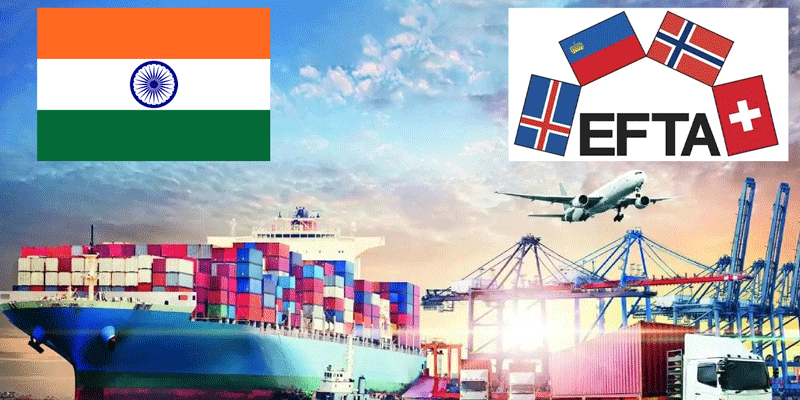
India–EFTA Pact Targets Investment, Jobs and Growth
Prime Minister Narendra Modi and Swiss Confederation President Guy Parmelin placed trade, investment and mobility at the heart of their New Delhi discussions, with the India–EFTA Trade and Economic Partnership Agreement (TEPA) emerging as the central economic pillar. Modi linked the pact to an ambitious target of $100 billion in investment and one million direct jobs in India over 15 years.
A Partnership Built on Economic Trust
India and Switzerland have maintained close diplomatic and economic relations, supported by strong commercial ties, technology cooperation, education and people-to-people exchanges. Switzerland is also an important European partner for India in finance, innovation, pharmaceuticals, infrastructure and advanced manufacturing.
The wider EFTA grouping—Switzerland, Norway, Iceland and Liechtenstein—gives TEPA a broader economic significance. Implemented in October 2025, it represents India’s first free-trade agreement with a European economic bloc and seeks to combine greater market access with long-term investment commitments.
TEPA: From Trade Agreement to Investment Engine
Modi described TEPA as a blueprint for “investment, innovation, jobs and mutual prosperity.” The agreement is designed to expand opportunities for Indian exporters while creating a more attractive environment for EFTA businesses.
Key sectors expected to benefit include:
· Agriculture and food processing
· Pharmaceuticals and life sciences
· Textiles and engineering
· Biotechnology and advanced manufacturing
· Banking, insurance and financial services
· Sustainability and clean technologies
The proposed $100-billion investment target is particularly significant because it could support industrial expansion, technology transfer and employment over an extended period.
Turning Commitments into Jobs
The investment and employment projections, however, should be viewed as long-term targets rather than immediate inflows. Their realisation will depend on the broader investment ecosystem in India.
Faster approvals, predictable regulations, robust intellectual-property protection, efficient logistics and greater ease of doing business will be crucial. Switzerland has also emphasised the importance of progress on an investment-protection agreement and intellectual-property issues.
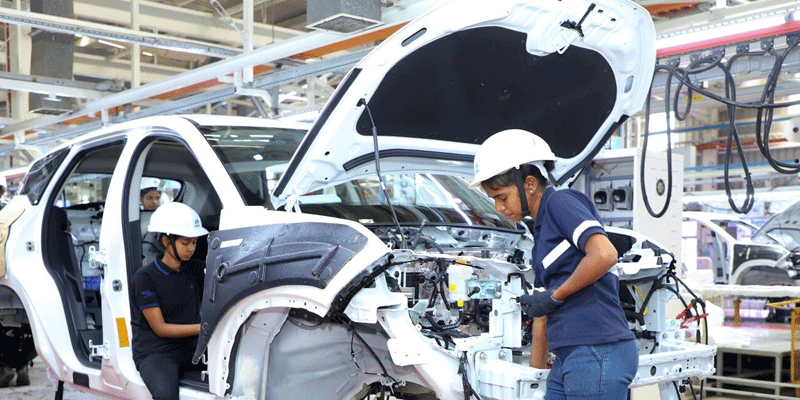
The success of TEPA will therefore depend on how effectively its commercial commitments translate into actual factories, research centres, infrastructure projects and skilled employment.
Mobility and Technology Deepen the Partnership
The leaders also signed five agreements covering migration and mobility, young professionals, transport and infrastructure, research, and technology transfer.
A young-professionals programme will initially permit up to 300 participants from each country annually, creating avenues for professional exposure and skills development. Mobility cooperation is also intended to address irregular migration and human trafficking.
Infrastructure emerged as another important area. Modi invited Swiss companies to participate in Indian projects involving tunnelling, railways, transport systems, airports and manufacturing, citing the Varanasi ropeway, Jewar airport and mountain railway projects.
Wider Strategic Cooperation
The discussions extended beyond economics to defence production, military exchanges, nuclear energy, health, clean energy and space research. Both leaders also discussed Ukraine, West Asia and reforms of global institutions.
From Ambition to Measurable Outcomes
India’s advancing relationship with the European Union further strengthens the significance of its European trade strategy. With the India–EU FTA negotiations concluded in January 2026, TEPA can complement India's broader push to integrate with European markets and investment networks.
Ultimately, the India–EFTA pact will be judged not by the scale of its projections but by investment actually delivered, exports generated, technology transferred and quality jobs created. Modi and Parmelin’s engagement signals an effort to transform longstanding goodwill into a durable economic partnership—one where trade becomes a catalyst for investment, innovation and employment.
(With agency inputs)