India’s external economy is showing renewed resilience even as geopolitical tensions and climate disruptions reshape global commerce. Fresh economic indicators suggest that the country’s foreign-exchange demand is expanding beyond metropolitan centres, its balance of payments (BoP) could swing back into a substantial surplus in FY27, and strategic partnerships with the United States and Japan are increasingly centred on technology and supply-chain security. At the same time, Europe’s costly heatwaves and volatile oil markets serve as reminders that India’s economic stability still depends on navigating global risks.
A Stronger Cushion for India’s External Sector
The latest projections indicate that India’s external finances may be entering a stronger phase after a challenging year. SBI Research estimates that the country’s BoP could record a surplus of nearly $50 billion in FY27, compared with an estimated $23.6 billion deficit in FY26, while the current-account deficit is expected to remain close to 1% of GDP.
A BoP surplus means that inflows from exports, services, remittances, foreign investment and capital movements exceed outflows, allowing the Reserve Bank of India greater room to strengthen foreign-exchange reserves and support rupee stability during periods of global volatility.
However, much of this optimism rests on sustained capital inflows rather than a dramatic improvement in merchandise exports.
Foreign Exchange Demand Expands Beyond Metros
Leisure travel accounts for 57% of forex demand, followed by corporate travel at 27% and overseas education at 16%. Digital adoption is also accelerating, with online transactions accounting for one-fourth of forex purchases and app-based usage rising sharply year-on-year.
The trend highlights how international travel, education and business engagement are becoming less concentrated in India’s largest cities.
Technology Partnerships Shape Economic Security
India’s external strategy is increasingly linked to technological cooperation with major partners.
The United States has identified artificial intelligence, semiconductors, defence and energy as pillars of an expanding economic relationship that has grown from around $20 billion to over $240 billion in goods-and-services trade over two decades, with an ambition of reaching $500 billion by 2030.
Meanwhile, India’s partnership with Japan is deepening through cooperation on semiconductors, critical minerals, clean energy, ICT and battery supply chains, strengthening efforts to reduce dependence on concentrated global manufacturing networks.
Europe’s Climate Shock Carries Global Consequences
Even as India’s outlook improves, developments abroad underline growing vulnerabilities. Europe’s prolonged heatwaves and drought are expected to reduce European Union output by around 1%, equivalent to nearly €180 billion.
The damage extends across agriculture, transport, power generation and labour productivity, while low water levels in the Rhine threaten German industrial activity. These disruptions could weaken European demand for imports and create fresh supply-chain bottlenecks with wider global consequences.
Resilience Must Keep Pace with Global Risks
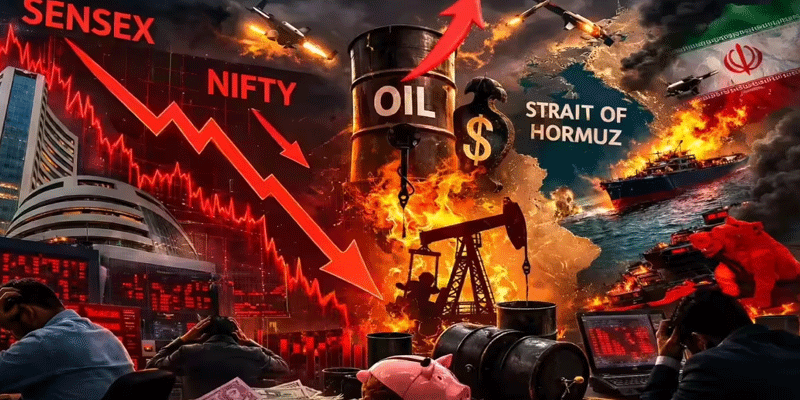
India’s projected BoP surplus offers an important economic buffer, but it does not insulate the country from external shocks. Rising oil prices, climate-driven disruptions and changing global investment flows can still influence inflation, exports and currency stability.
The encouraging signs—strong services exports, expanding forex participation and strategic technology partnerships—provide a foundation for resilience. Yet sustaining that advantage will require diversified export markets, secure energy supplies, continued investment in high-value manufacturing and careful management of external risks. In an increasingly unpredictable global economy, India’s greatest strength will lie not merely in accumulating reserves, but in building an external sector capable of absorbing shocks while supporting long-term growth.
(With agency inputs)