Shah Ends Speculation Over Akali Alliance
Putting an end to months of speculation about a possible reconciliation with the Shiromani Akali Dal (SAD), Union Home Minister Amit Shah announced that the Bharatiya Janata Party (BJP) will contest the 2027 Punjab Assembly elections independently.
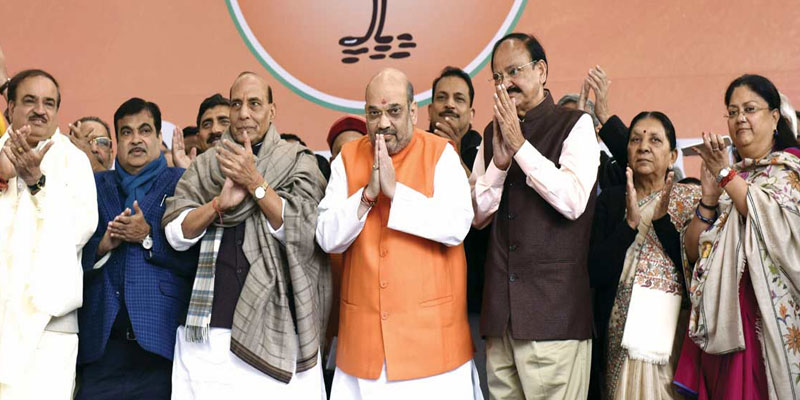
Speaking at the party’s “Badlaav Rally” in Killi Chahlan, Moga, Punjab, India on March 14, 2026, Shah declared that the BJP would field candidates in all 117 constituencies of the state assembly. The announcement effectively confirms the end of the decades-long BJP–SAD partnership that collapsed in 2020 during the controversy over farm laws.
Shah’s message was direct and symbolic: the BJP, he said, would no longer play the role of the “chhota bhai” (junior partner) in Punjab politics.
Breaking with the Akali Legacy
For years, the BJP contested elections in Punjab as a smaller partner to the Akali Dal, focusing mainly on urban constituencies while SAD dominated rural Sikh-majority regions. That arrangement ended after the farm law protests strained relations between the two parties.
In the 2022 Punjab Assembly elections, the BJP contested independently and secured just two seats with about 6.6 percent of the vote. However, the party believes the political landscape is gradually shifting.
During the 2024 parliamentary elections, the BJP increased its vote share in Punjab to roughly 19 percent, even though it failed to win any seats. Party strategists now see this as a foundation for future expansion, similar to how the BJP gradually built strength in states such as Assam and Haryana.
Targeting Drugs, Conversion and Governance Issues
A major theme of Shah’s speech focused on law and order in Punjab, particularly the problem of narcotics trafficking. He claimed that a large portion of heroin smuggling into India is routed through Punjab from neighboring regions including Pakistan and Afghanistan.
Shah promised that if the BJP forms the government, it would launch a major crackdown using central investigative agencies such as the National Investigation Agency and the Central Bureau of Investigation to dismantle drug networks within two years.
He also pledged that the BJP would introduce an anti-conversion law shortly after assuming power, arguing that such legislation would protect cultural and religious traditions while countering what he described as vote-bank politics.
Sharp Criticism of the Current Government
Shah directed strong criticism at the ruling Aam Aadmi Party government led by Chief Minister Bhagwant Mann. He accused the administration of failing to control drug abuse and mismanaging Punjab’s finances.
In a pointed remark, Shah alleged that Mann was acting under the political influence of AAP leader Arvind Kejriwal, claiming the state government was unable to address rising debt and governance challenges.
The BJP hopes that dissatisfaction with the current government—combined with the weakening of traditional parties such as the Akali Dal and the Indian National Congress—will create an opportunity for it to emerge as a viable alternative.
Launching a New Political Strategy
The rally in Moga, held under the slogan “Aao Miljul Ke Badliye Punjab,” marked the formal launch of the BJP’s campaign for the next assembly election. The choice of the Malwa region—traditionally a stronghold of the AAP—signals the party’s intention to expand beyond its traditional urban voter base.
BJP leaders believe that a combination of urban voters, sections of the Sikh community, and non-resident Punjabis could help the party significantly increase its electoral footprint in the state.
A New Chapter in Punjab Politics
Amit Shah’s announcement represents a decisive shift in the BJP’s approach to Punjab. By choosing to contest alone, the party is betting that the state’s evolving political dynamics will allow it to grow beyond its historical limits.
The road to power in Punjab remains challenging, but the BJP’s strategy signals confidence that the political landscape is ready for change. As the 2027 elections approach, the state may witness a more competitive contest than ever before—one that could reshape Punjab’s political future.
(With agency inputs)