A Moment That Spoke Louder Than Words
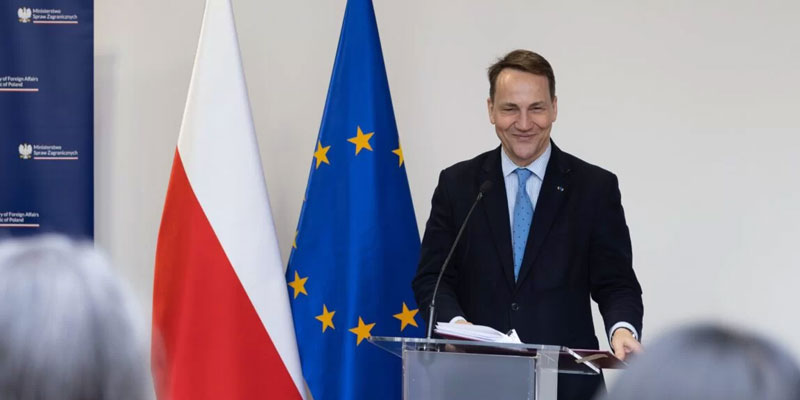
Polish Foreign Minister Radosław Sikorski abruptly walked away from a reporter’s question on India’s concerns over Pakistan-sponsored cross-border terrorism during a press interaction in New Delhi, triggering instant attention. The unscripted moment, marked by visible discomfort, came after a day of unusually candid exchanges between Indian and Polish leadership, turning a routine diplomatic visit into a revealing episode about unresolved tensions beneath an otherwise growing partnership.
A Partnership Tested in Public
India and Poland have steadily expanded ties in recent years, upgrading their relationship to a strategic partnership and deepening cooperation in defence, trade, and technology. Yet diplomacy is as much about perception as policy. Sikorski’s refusal to engage publicly on terrorism—one of India’s core national security concerns—highlighted how a single media moment can expose deeper disagreements, particularly when those disagreements touch on sovereignty and regional conflict.
The Immediate Context: Jaishankar’s Direct Message
Earlier the same day, External Affairs Minister S. Jaishankar delivered an unusually forthright message during bilateral talks. Without naming Pakistan directly, he urged Poland to maintain “zero tolerance” toward terrorism and warned against actions that could strengthen terrorist infrastructure in India’s neighbourhood. The remarks were widely interpreted as a reference to Poland’s recent engagement with Pakistan and its October 2025 joint statement with Islamabad.
When questioned by the media on this issue, Sikorski avoided a direct response. Instead of clarifying Poland’s position, he ended the interaction abruptly, a move that amplified the sense of diplomatic unease rather than containing it.
Poland–Pakistan Statement and India’s Reaction
At the heart of the tension lies Poland’s joint statement with Pakistan that referenced the Kashmir issue. For New Delhi, this was not a neutral diplomatic gesture but a troubling departure from the widely accepted position that Kashmir is a bilateral matter between India and Pakistan. By echoing Pakistani language, even indirectly, Warsaw was seen as lending legitimacy to Islamabad’s narrative while remaining silent on its record of cross-border terrorism.
India viewed this as “selective criticism,” particularly frustrating given its efforts to persuade European partners to adopt a more consistent approach toward terrorism emanating from Pakistan. The statement strained India–Poland ties, prompting India to raise its concerns openly rather than behind closed doors—a sign of both irritation and confidence in the relationship.
Discomfort Without Breakdown
Sikorski’s walkout suggested personal and political unease with the line of questioning, but it did not signal a collapse in engagement. His subsequent hour-long meeting with National Security Advisor Ajit Doval indicated that substantive dialogue continued away from the cameras. Polish officials later reiterated support for counter-terrorism cooperation, attempting to reassure India without formally revisiting the Pakistan statement.
This dual-track approach—awkward public optics paired with steady private diplomacy—helped prevent a temporary rift from becoming a lasting rupture.
A Reminder of Diplomatic Red Lines
The episode serves as a reminder that symbolic gestures and carefully worded statements matter deeply in international relations. For India, terrorism and territorial integrity remain non-negotiable red lines. For Poland, balancing outreach to South Asia while aligning with Indian sensitivities requires greater diplomatic calibration. While the incident has not derailed India–Poland relations, it underscores that strategic partnerships thrive not only on shared interests, but also on an acute awareness of each other’s core security concerns.
(With agency inputs)