The Bagram Question Returns
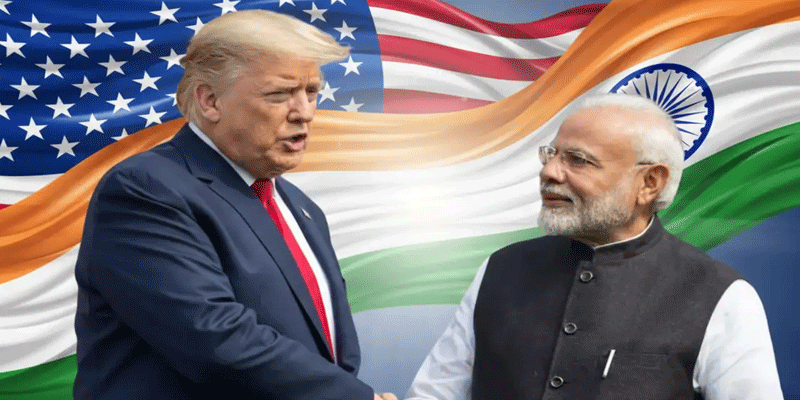
Nearly five years after the United States withdrew from Afghanistan, Bagram Air Base — once the nerve centre of Washington’s “war on terror” — has re-emerged as a flashpoint in global geopolitics. US President Donald Trump, seeking to reassert America’s military presence in the region, recently demanded that the Taliban hand over control of Bagram to Washington. The proposal has reignited old tensions, drawing sharp opposition from across Asia — and, in a striking development, India has joined the chorus of dissent.
At a recent Moscow Format Consultation on Afghanistan, New Delhi sided with China, Russia, Pakistan, Iran, and the Taliban-led Afghan government in rejecting any attempt by external powers to redeploy military infrastructure within Afghanistan or its neighbouring territories. The move reflects a calculated recalibration in India’s regional policy — one that privileges stability, sovereignty, and pragmatic diplomacy over great-power alignment.
A United Regional Front Against Washington’s Push
The strongly worded joint communique from the Moscow meeting did not explicitly name Bagram but left little room for ambiguity. The participants declared that any attempt by outside nations to re-establish military bases in or around Afghanistan was “unacceptable” and detrimental to regional peace.
The meeting, attended by representatives from India, China, Pakistan, Iran, Russia, Kazakhstan, Kyrgyzstan, Tajikistan, Uzbekistan, and Afghanistan, marked a diplomatic milestone: for the first time, the Taliban’s Foreign Minister Amir Khan Muttaqi joined the consultation as a full member. That India signed onto a statement including the Taliban as an equal partner underscores a significant shift in New Delhi’s engagement strategy — from isolation to cautious inclusion.
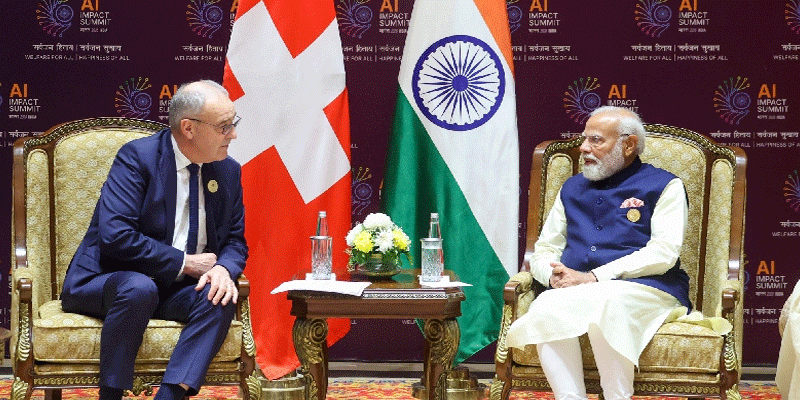
Observers note that India’s stance was not so much an endorsement of the Taliban regime as a rejection of unilateral interventionism. With the Taliban foreign minister scheduled to visit New Delhi later this week, the timing signals a subtle but strategic outreach — one that seeks to balance India’s interests in counterterrorism, regional stability, and connectivity.
Trump’s Demand and the Taliban’s Defiance
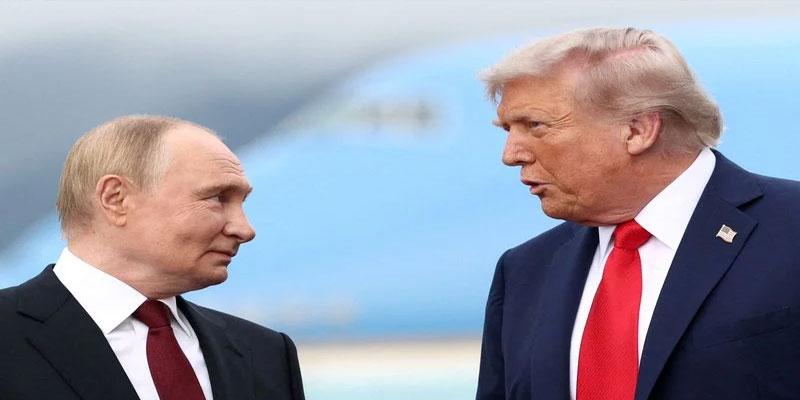
Trump’s remarks at a joint press conference with UK Prime Minister Keir Starmer on September 18 set off the latest controversy. Expressing frustration, he declared that the United States was “trying to get Bagram back,” lamenting that the base had been “given away for nothing.” Days later, he doubled down on his social media platform, warning that “bad things” could happen if Afghanistan refused to comply.
The Taliban’s swift rebuttal was unequivocal. Spokesperson Zabihullah Mujahid asserted that Afghanistan would “never allow its land to be handed over to anyone under any circumstances.” The response reflected both nationalist pride and a bid for legitimacy — positioning the Taliban as guardians of Afghan sovereignty against foreign pressure.
For India, which has long emphasised respect for Afghanistan’s territorial integrity, this convergence of interests — however temporary — explains its endorsement of the Moscow statement’s language.
The Strategic Weight of Bagram
Located about 50 kilometres north of Kabul, the Bagram airfield is Afghanistan’s largest and most fortified base, equipped with two major runways capable of handling heavy transport and combat aircraft. Its control offers immense strategic and symbolic value, providing oversight of routes into Central and South Asia. For Washington, reclaiming Bagram would restore a critical foothold near the Chinese, Iranian, and Russian spheres of influence. For the region, however, it represents a potential spark for renewed militarisation and instability.
India’s participation in the joint opposition thus reflects a broader concern over re-militarisation of the Afghan theatre. The statement’s call to “strengthen counter-terrorism cooperation” and “support Afghanistan’s self-reliance” aligns with India’s consistent advocacy for developmental and humanitarian engagement rather than armed presence.
Pragmatism Over Alignment
By joining hands with unlikely partners — including the Taliban and Pakistan — India has sent a clear signal: its Afghanistan policy is driven by regional realism, not ideological rigidity. The message to Washington is equally pointed — stability in Afghanistan must arise from regional consensus, not external coercion.
The upcoming visit of Amir Khan Muttaqi to New Delhi, enabled by a UN travel waiver, could test this recalibrated approach. Whether it leads to deeper dialogue or merely symbolic engagement, one thing is evident — India is positioning itself as a responsible stakeholder in the region’s future, seeking peace through diplomacy, not deployment.
In the unfolding contest over Bagram, Delhi’s quiet defiance underscores a new strategic maturity: choosing cooperation over confrontation, and principle over pressure.
(With agency inputs)