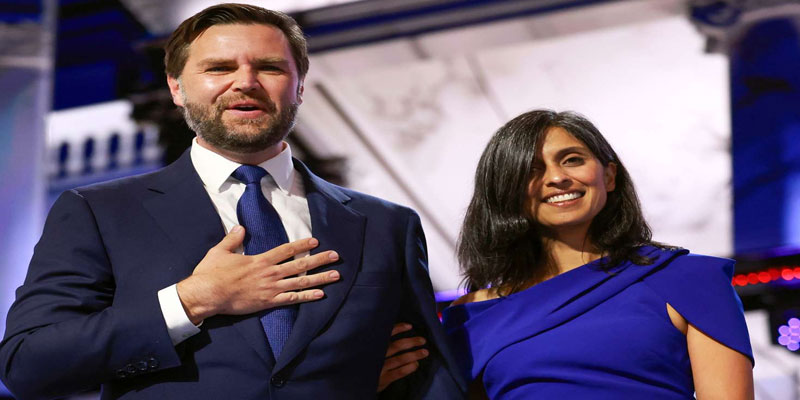
United States Vice President JD Vance has found himself at the center of a heated controversy after publicly expressing hope that his Indian-origin Hindu wife, Usha Vance, might one day convert to Christianity.
Speaking at a Turning Point USA event in Mississippi on October 29, 2025, Vance discussed his personal faith and family life, saying that while Usha often attends church with him, he “hopes she will eventually embrace the faith that changed [his] life.”
While intended as a reflection on personal belief, his comments quickly drew widespread criticism for appearing to devalue Hinduism and for raising concerns about religious sensitivity, especially given his wife’s Indian heritage and the couple’s interfaith background.
Vance’s Faith and Family Journey
JD Vance, known for his bestselling memoir Hillbilly Elegy, was raised in a Protestant evangelical family in Ohio but drifted away from religion during his early adult years, describing himself as agnostic through law school.
By 2019, Vance converted to Catholicism, a shift he attributed to both spiritual reflection and the grounding influence of his wife, Usha. Ironically, though she comes from a Hindu family, Usha is known to be “not particularly religious.” The couple raises their children within the Christian faith, while maintaining an interfaith home that Vance had previously described as “respectful and balanced.”
During his Mississippi remarks, Vance emphasized that his wife’s current beliefs “don’t cause a problem” in their marriage, but his open wish for her conversion — “I hope one day she’ll be moved by the gospel” — became the flashpoint for criticism.
Backlash and Community Response
The reaction was swift and sharp across media and diaspora communities.
· Accusations of Insensitivity: Many Indian-American voices and Hindu organizations criticized Vance for what they saw as disrespect toward Hinduism, implying it was incomplete or inferior to Christianity. Commentators called his words “tone-deaf” and “patronizing,” given that his marriage had celebrated Hindu customs and rites.
· Political Overtones: Analysts suggested the statement could be a strategic appeal to the conservative Christian base, aligning with his populist rhetoric, but at the cost of alienating minority and interfaith communities.
Clarifications from Usha Vance
Responding to the uproar, Usha Vance issued a statement affirming that she and JD share “an interfaith family built on mutual respect” and that she has no plans to convert. She underscored that “faith is deeply personal” and not something to be publicly debated or politicized.
Social media also saw a wave of discussion about diaspora identity, questioning whether Vance’s comments inadvertently reinforced stereotypes about assimilation and cultural superiority.
Religion, Politics, and Public Perception
The controversy highlights the fragile intersections of faith, politics, and identity in contemporary America. While religious freedom is constitutionally enshrined, expectations of conversion within high-profile families often stir debate about tolerance, pluralism, and private belief in public office.
In an era of deep political polarization, Vance’s words became a litmus test for cultural sensitivity — interpreted by some as sincere faith, but by others as cultural condescension. For many Indian-Americans, the episode revived questions about how immigrant heritage and faith traditions are treated within the U.S. mainstream narrative.
A Lesson in Public Sensitivity
JD Vance’s candid reflections on his wife’s faith were intended to share a personal spiritual journey, but instead ignited a national debate about respect and representation. The backlash underscores how private convictions, when voiced publicly by elected leaders, can carry deep political and cultural resonance.
The episode serves as a reminder that interfaith relationships in public life demand empathy and restraint — not declarations of conversion or hierarchy. As the Vice President faces scrutiny, his remarks reveal broader truths about America’s ongoing struggle to balance faith, diversity, and public responsibility in a society built on freedom of belief.
(With agency inputs)