A Diplomatic Push Across Asia
Uttar Pradesh Chief Minister Yogi Adityanath embarked on a high-profile visit to Singapore and Japan, reinforcing the state’s aggressive global outreach for foreign direct investment (FDI). The tour, spanning strategic meetings, investor roundtables, and site visits, underscored Uttar Pradesh’s ambition to transform from a traditionally agrarian state into a diversified industrial and technology hub.
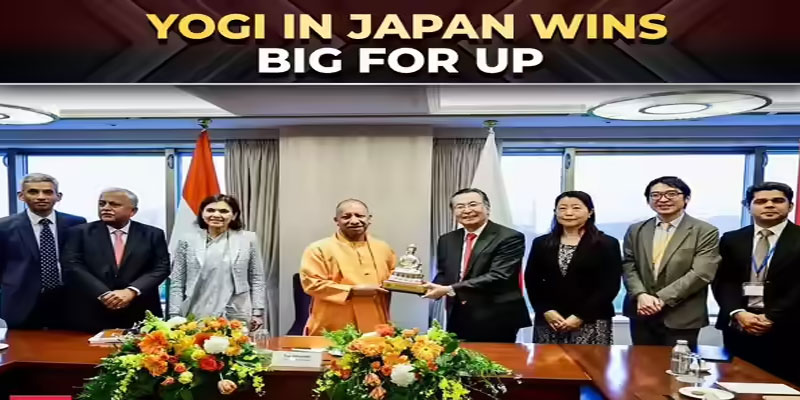
In Japan’s Yamanashi Prefecture, Yogi projected Uttar Pradesh (UP) as “the best place for investment,” drawing parallels between Yamanashi’s natural wealth and UP’s vast demographic and economic potential. Earlier in Singapore, he met Prime Minister Lawrence Wong and senior ministers, consolidating partnerships that signal a new phase in UP’s FDI diplomacy.
Pitching Uttar Pradesh as an Investment Magnet
At the heart of Yogi’s outreach was a carefully constructed narrative of transformation. He emphasized that UP, with a population of 25 crore, represents India’s largest consumer market—offering unmatched scale for manufacturing, digital services, and infrastructure development.
The Chief Minister highlighted improvements in law and order, infrastructure expansion, expressway connectivity, and industrial corridors as proof of a business-friendly ecosystem. Per capita income, he noted, has tripled over the past nine years, reflecting structural reforms and central-state coordination under what he termed a “double-engine” growth model.
UP’s ambition to become a $1 trillion economy by 2027 forms the backdrop to these engagements. The state’s Global Investors Summit has already generated substantial commitments; the Singapore and Japan visits aim to convert interest into capital inflows and technology partnerships in high-value sectors such as semiconductors, electric vehicles (EVs), renewable energy, and data infrastructure.
Singapore: ₹19,877 Crore in Strategic MoUs
The Singapore leg proved particularly fruitful. During the February 22–24 visit, UP secured investment commitments totaling ₹19,877 crore—often rounded to ₹20,000 crore—across six major Memoranda of Understanding (MoUs).
The largest share of investments targets data infrastructure. Golden State Capital committed ₹8,000 crore for a 100 MW data centre, while Universal Success Group pledged ₹6,650 crore for group housing, logistics parks, and a hyperscale data park in the Noida-Greater Noida region. Together, these reinforce UP’s ambition to emerge as a northern data hub.
Green energy and sustainability projects formed another pillar. The Private Infrastructure Development Group (PIDG) committed ₹2,500 crore toward renewable energy and green hydrogen initiatives, while AVPN Limited pledged ₹2,727 crore for renewable and agri-solar (Agri-PV) projects. Strategic partnerships with Singapore Cooperation Enterprise (SCE) and SATS focused on skill development and aviation logistics.
Collectively, these MoUs are expected to generate over 20,000 jobs and deepen institutional collaboration in digital infrastructure, logistics, and energy transition.
Japan: Technology, Manufacturing and Green Hydrogen
In Japan, Day 1 alone yielded proposals worth ₹11,000 crore. Agreements involved prominent firms including Kubota Corporation (farm machinery), Minda Corporation (auto electronics), and Japan Aviation Electronics Industry (avionics systems).
Yogi’s visit to the Yamanashi Hydrogen Facility P2G highlighted UP’s interest in Power-to-Gas technology for green hydrogen production—aligning with India’s net-zero ambitions and the state’s renewable energy roadmap.
A Calculated Leap Toward Economic Reinvention
Yogi Adityanath’s Singapore and Japan tour reflects a calibrated strategy to reposition Uttar Pradesh as a competitive investment destination. With cumulative commitments of over ₹31,000 crore across both countries, the state is attempting to bridge capital, technology, and demographic advantage.
Challenges such as land acquisition and implementation timelines remain. Yet sustained diplomatic engagement, policy stability, and sector-focused targeting suggest that UP is no longer content to trail established industrial states. Instead, it seeks to redefine itself—blending tradition with technology—as a rising economic engine in India’s growth story.
(With agency inputs)