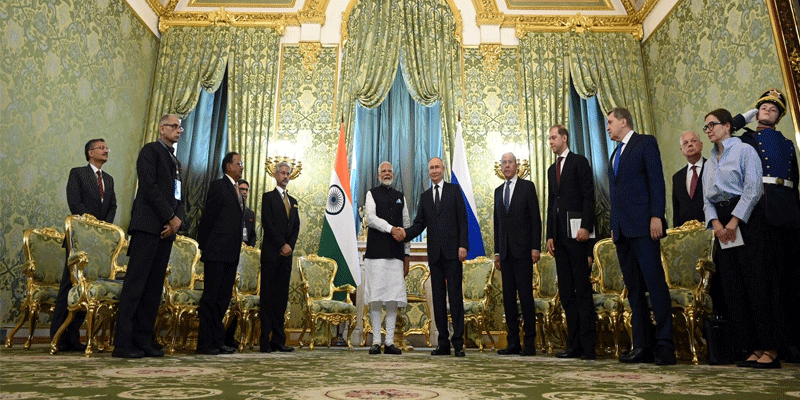
PM Modi and Putin discussed trade, investment, and energy cooperation in their bilateral meeting, underscoring Moscow’s continuing importance as a key strategic partner for New Delhi across multiple sectors. Their September 11, 2026 talks in New Delhi, held ahead of the BRICS summit, came as India navigates conflicts in Ukraine’s Black Sea theatre and West Asia, maritime disruptions and competing pressures from the United States, Russia, Iran, Israel and the Gulf.
A Relationship Under Strategic Pressure
India-Russia ties remain anchored in defence, energy and longstanding political trust. Russia continues to be a major military supplier, even as India diversifies procurement. Since the Ukraine conflict began in 2022, discounted Russian crude has also become central to India’s energy security. Russia reportedly accounted for a record 51% of India’s crude imports in July 2026, partly reflecting disruptions in Middle Eastern supplies.
The two countries aim to raise bilateral trade to $100 billion by 2030, from nearly $70 billion in 2024-25. Beyond trade, the relationship covers fertilisers, nuclear energy, critical minerals, defence technology and transport corridors. For Moscow, India remains a major economic partner despite Western sanctions.
Putin’s BRICS Vision Meets India’s Pragmatism
Putin used the BRICS platform to advocate stronger economic structures beyond Western-dominated financial and trading systems, criticising sanctions, secondary sanctions and disruptions to transport and maritime networks.
Russia wants BRICS to develop alternative payment channels, local-currency trade, joint infrastructure and stronger business and technology cooperation. India supports greater economic cooperation but avoids portraying BRICS as an anti-Western bloc.
That distinction is crucial. Modi has emphasised removing trade barriers, digital payments, startups and artificial intelligence rather than geopolitical confrontation. India seeks strategic autonomy, not strategic isolation.
The Economic Calculation
India’s expanding BRICS engagement also carries risks. Data cited by the Global Trade Research Initiative show India’s trade deficit with the 11-member grouping rising from $74.5 billion in FY2021 to $226.1 billion in FY2026. Goods trade doubled to $417.5 billion, but imports expanded much faster than exports.
China is central to this imbalance. Chinese imports more than doubled to $131.6 billion, while Indian exports to China declined by 8.1%. A deeper BRICS economic framework could therefore increase Indian dependence on China unless trade barriers and export asymmetries are addressed.
Maritime Security Becomes Economic Security
The Ukraine and West Asia conflicts have also made maritime security a central diplomatic concern. Disruptions in the Black Sea and key West Asian Sea lanes threaten energy supplies, freight costs, insurance, fertiliser movement and Indian seafarers.
Modi’s emphasis on dialogue, diplomacy, freedom of navigation and the safety of Indian nationals reflects a carefully calibrated position. India cannot afford prolonged disruption to the routes supporting its energy and external trade.
Balancing Iran, Israel and the Gulf
India’s engagement with Iranian President Masoud Pezeshkian further demonstrated this balancing act. New Delhi values Iran for connectivity through Chabahar and the International North-South Transport Corridor, while simultaneously deepening relations with Israel, Saudi Arabia, the UAE and the United States.
India therefore needs Tehran for connectivity, Moscow for defence and energy, the Gulf for capital and energy, Israel for technology and security, and Washington and Europe for investment and advanced technology.
Strategic Autonomy Must Deliver Economic Leverage
The Modi-Putin outreach signals that India will not abandon Russia under external pressure, but neither will it allow the relationship to restrict its wider choices. India’s strategic balancing will succeed only if diplomatic flexibility translates into secure energy, resilient maritime routes, diversified trade and stronger economic leverage. New Delhi’s real test is not choosing sides, but ensuring that every partnership expands India’s room for manoeuvre.
(With agency inputs)