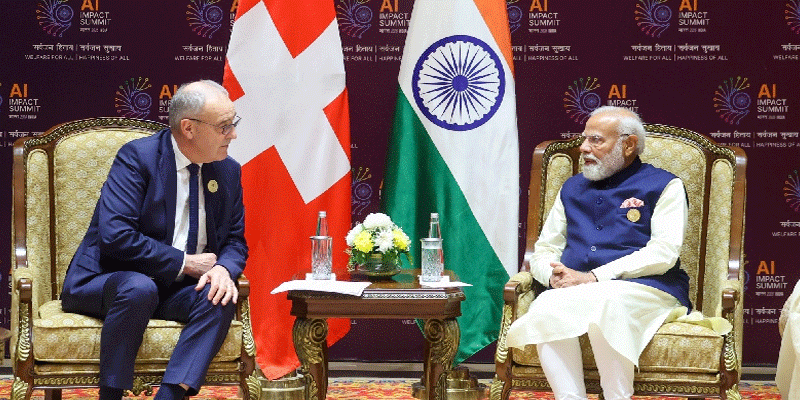
Piyush Goyal has called for an accelerated India-Russia economic partnership to lift bilateral trade from around $60 billion to $100 billion by 2030, alongside a proposed $50 billion two-way investment target. Speaking at the INNOPROM India 2026 co-chair plenary in New Delhi with Russian Industry and Trade Minister Anton Alikhanov, Goyal stressed that achieving the ambition would require sustained double-digit growth and a fundamental broadening of the relationship.
A Record Trade Relationship with An Imbalance
India-Russia trade has expanded sharply in recent years, reaching a record $68.7 billion in 2024-25 before moderating to about $60 billion in 2025-26. Yet the headline figure masks a striking imbalance. India’s exports remain below $5 billion, while Russian exports exceed $55 billion, overwhelmingly reflecting India’s purchases of crude oil and other energy products.
The central challenge is therefore not simply increasing trade, but making it substantially more balanced and resilient.
Moving Beyond the Oil-Driven Partnership
Russian oil became increasingly important to India after the Ukraine conflict disrupted Moscow’s traditional markets and redirected discounted supplies towards Asian buyers. India benefited through greater energy security and competitive import costs, while Russia gained access to one of the world’s largest energy markets.
However, an energy-dominated relationship remains vulnerable to oil-price fluctuations, sanctions, shipping disruptions and geopolitical developments. Goyal’s emphasis on pharmaceuticals, engineering products, chemicals, textiles, food, automobiles and components signals an effort to turn exceptional energy commerce into a wider industrial partnership.
Some exports are already showing momentum. Indian meat and edible meat products shipped to Russia increased from $36 million to $97 million, while fish and aquatic products rose from $123 million to $159 million. Vegetable exports reached $54 million, while coffee, tea and spices climbed 13% to $116 million.
Yet their overall contribution remains modest. The additional $61 million generated by meat exports, for instance, represents less than 0.2% of the roughly $40 billion increase needed to reach the 2030 target. The challenge is consequently one of scale as much as diversification.
Investment Could Change the Equation
Investment and manufacturing could provide the missing scale. A proposed bilateral investment treaty could offer greater legal certainty, while negotiations for a free-trade agreement between India and the Russia-led Eurasian Economic Union could expand access to Russia, Belarus, Kazakhstan, Kyrgyzstan and Armenia.
Alikhanov has identified rare earths and microelectronics as potential cooperation areas and invited Indian pharmaceutical companies to manufacture active pharmaceutical ingredients in Russia. Such investments could reduce logistical barriers while strengthening industrial supply chains.
Goyal, meanwhile, has urged Russian companies to manufacture in India rather than simply export into the Indian market, while encouraging Indian businesses to invest in Russia. This two-way manufacturing model could create more sustainable trade flows.
Payments And Market Access Remain Critical
Local-currency settlement mechanisms are being strengthened, but payment friction, sanctions compliance, logistics, certification, standards and regulatory approvals continue to constrain commerce. Businesses will need predictable rules and commercially viable channels to expand exports at the required pace.
The $100 Billion Test Is About Economic Transformation
India and Russia have a strong political foundation, but $100 billion by 2030 will require an economic transformation. Higher oil purchases can lift trade temporarily; they cannot create a durable, balanced partnership.
The real test will be whether India can dramatically expand competitive exports, Russia can provide meaningful market access, and both sides can convert investment, manufacturing and technology cooperation into new commercial ecosystems. Only then can the $100 billion ambition become a sustainable economic milestone rather than another trade headline.
(With agency inputs)