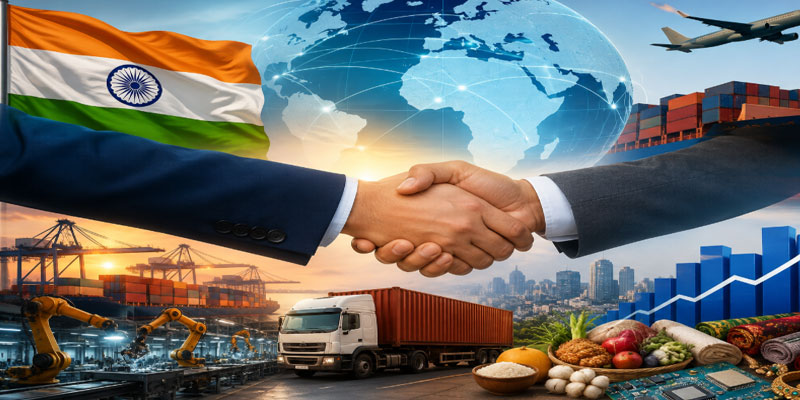
India’s FTA Expansion Strategy
India is rapidly expanding its free-trade-agreement network with an ambitious objective: bringing around 75% of global trade within its FTA framework. Commerce and Industry Minister Piyush Goyal said in Tokyo on August 24 that India is negotiating agreements with eight or nine additional countries and regional groupings representing nearly $15 trillion in combined GDP. The strategy signals a significant evolution from earlier trade caution towards selective, broad-based economic integration.
From Trade Protection to Global Integration
India’s renewed FTA push comes as global supply chains are being reshaped by US-China strategic competition, tariff uncertainty and geopolitical disruptions. Multinational companies are increasingly seeking alternatives to concentrated manufacturing bases. This creates a potential “China-plus-one” opportunity for India, provided it can combine its large market and workforce with predictable access to overseas consumers.
Over the past four years, India has signed nine FTAs covering 38 developed economies with a combined GDP of roughly $60 trillion. Including earlier arrangements, New Delhi says preferential access now extends to economies representing around $70 trillion in GDP.
Building a Wider Trade Architecture
India’s expanding network includes agreements with Mauritius, the UAE and Australia, alongside the Trade and Economic Partnership Agreement with the European Free Trade Association—Switzerland, Norway, Iceland and Liechtenstein. Agreements or concluded negotiations with the UK, Oman, New Zealand, and the European Union further strengthen access to high-income consumer markets, investment, and technology.
The next phase could widen this architecture substantially. India is pursuing or considering negotiations with the United States, Canada, Israel, Chile, Peru, the Eurasian Economic Union and Maldives, while FTA negotiations with the Gulf Cooperation Council are also underway. New Delhi is simultaneously seeking to upgrade existing arrangements with ASEAN, South Korea and Australia.
This diversification is strategically important: India would be less dependent on individual markets or geopolitical blocs while creating more pathways for Indian companies to participate in global value chains.
Japan Shows How Trade Meets Investment
Goyal’s Tokyo visit demonstrates that trade diplomacy is increasingly being linked with investment diplomacy. Leading a business delegation of more than 200 representatives, he is seeking stronger Japanese partnerships in trade, investment, technology and manufacturing.
For Indian exporters, wider FTAs could mean lower tariffs, clearer rules of origin and improved access for services. Labour-intensive sectors such as textiles, leather, food processing and engineering, alongside pharmaceuticals and manufacturing, could gain from larger overseas markets and cheaper access to selected inputs.
Market Access Must Become Market Success
FTAs, however, cannot guarantee export growth. Indian businesses must meet demanding quality standards, navigate rules of origin and overcome logistics and regulatory barriers. Greater import competition could also pressure vulnerable domestic industries.
That makes complementary reforms essential—from ports and customs to skills, financing, standards, and reliable industrial inputs.
Turning Trade Agreements into Global Competitiveness
India’s FTA expansion is ultimately a strategic bet: connect the world’s major markets to India’s manufacturing and consumption potential, and make both reinforce each other. If implementation is backed by domestic competitiveness reforms, India can move beyond being a vast standalone market and become a more deeply integrated, reliable and attractive global trading partner. The real measure of success will not be the number of agreements signed, but the exports, investments, jobs and value chains they generate.
(With agency inputs)