Protecting People, Securing Energy
India has managed to protect the interests of nearly 10 million Indians living and working across the Gulf while keeping oil and gas supplies flowing despite the worsening West Asia conflict. External Affairs Minister S. Jaishankar told Parliament’s Consultative Committee on External Affairs that New Delhi’s response rested on three priorities: safeguarding the diaspora, protecting energy security and sustaining political engagement with Gulf partners.
A Crisis with Direct Stakes for India
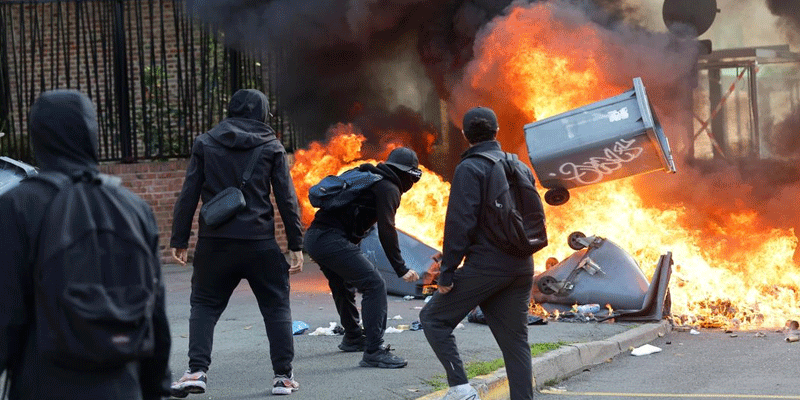
The conflict that erupted on February 28, 2026, quickly transformed the Strait of Hormuz into a critical pressure point for global energy and maritime trade. Attacks on commercial shipping, military confrontation and restrictions on vessel movement disrupted one of the world’s most important energy corridors. India’s vulnerability was particularly high because the Gulf is central not only to its crude and gas supplies but also to trade, remittances and the livelihoods of millions of Indian citizens.
India therefore adopted a calibrated approach—maintaining communication with competing regional powers while avoiding alignment with any single bloc.
Gulf Diplomacy Built Around People and Energy
Protecting Indians became the immediate humanitarian priority. New Delhi remained in contact with Gulf governments to ensure the safety and welfare of its citizens, while also supporting Indian seafarers exposed to risks on commercial vessels. Prime Minister Narendra Modi had earlier told Parliament that Indians in affected countries were being provided necessary assistance and that Gulf leaders had assured their safety.
Energy security formed the second pillar. Jaishankar has stressed that India cannot afford disruption to affordable energy supplies and has supported diversification of sources alongside diplomatic efforts to keep maritime routes open. India has consistently called for safe and unimpeded navigation through the Strait of Hormuz, arguing that commercial shipping must not become a target in the conflict.
The strategy also involves strengthening strategic reserves and maintaining flexibility in sourcing. India’s broader objective is to reduce the vulnerability created by excessive dependence on any single route or supplier.
Latest Developments Raise the Stakes
The situation remains highly fluid. Shipping through Hormuz has again fallen sharply, with only seven commodity vessels recorded crossing the strait on September 7, according to Kpler data cited by Reuters. Iran has also threatened further restrictions, while Gulf states are exploring alternative energy and trade routes to reduce dependence on Hormuz.
Energy markets remain under pressure, with Brent crude approaching $100 a barrel amid renewed tensions. Meanwhile, Qatar and the UAE have resorted to ship-to-ship LNG transfers outside Hormuz, including cargoes ultimately destined for India, illustrating the extraordinary measures now required to sustain energy flows.
The Real Test: Turning Diplomacy into Resilience
India’s Gulf strategy is ultimately about protecting people while protecting the economy. By maintaining dialogue with Gulf capitals, Iran and other major stakeholders, New Delhi has sought to keep its citizens safe, energy supplies moving and trade routes open without becoming trapped in regional rivalries.
The latest crisis demonstrates that India’s Gulf diplomacy is no longer merely about bilateral relations or oil imports. It has become an essential instrument of national resilience, combining humanitarian responsibility, strategic autonomy, energy diversification and sustained political engagement. As tensions continue, the real measure of India’s diplomacy will be its ability to keep both people and energy secure through prolonged uncertainty.
(With agency inputs)